
The practical takeaway
When you are planning a trip to Japan, working out how to get from Tokyo to Kyoto is one of the first logistical hurdles you will face. As the two most visited cities in the country, the route between them is heavily…
When you are planning a trip to Japan, working out how to get from Tokyo to Kyoto is one of the first logistical hurdles you will face. As the two most visited cities in the country, the route between them is heavily traveled and well serviced. The good news is that for the vast majority of visitors, the Tokyo to Kyoto Shinkansen (bullet train) is the definitive answer.
However, there are other choices, including domestic flights, overnight buses, and private transfers. Depending on your budget, whether you are holding a rail pass, and how much time you have available in your 7-day Japan itinerary or 14-day Japan itinerary, those alternatives are worth understanding.
This guide breaks down exactly what to expect from each option for the Tokyo to Kyoto route, including the Tokyo to Kyoto cost, travel times, and practical advice on luggage and seating.
Some links in this guide are affiliate links. FlyFono may earn a commission if you book through them, at no extra cost to you. Recommendations are based on practical relevance, not commission.
Compare Japan rail passes and Shinkansen ticket options.
Quick comparison table: Tokyo to Kyoto
| Option | Time | Cost est. | Best for | Luggage |
|---|---|---|---|---|
| Shinkansen (Bullet Train) | 2h15m – 4h | ¥13,000 – ¥14,500 | Most visitors, speed and comfort | Strict rules for oversized bags |
| Overnight Bus | 7h – 8h | ¥3,000 – ¥9,000 | Budget travelers, saving on a hotel | Usually 1 large bag in the hold |
| Domestic Flight | ~1h flight (3h+ total) | ¥7,000 – ¥20,000+ | Connecting directly from Narita/Haneda | Depends on airline allowance |
| Driving (Rental Car) | 5.5h – 6.5h | High (rental, tolls, gas) | Those exploring rural areas en route | As much as fits in the car |
| Private Transfer | 5.5h – 6.5h | ¥80,000+ | Large groups with high budgets | Depends on vehicle size |
Tokaido Shinkansen — the standard choice
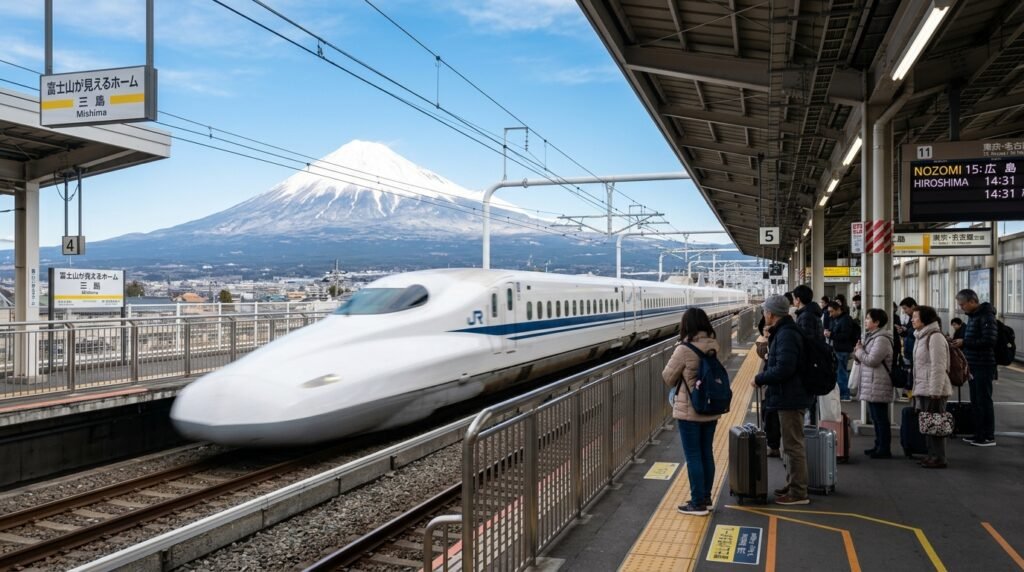
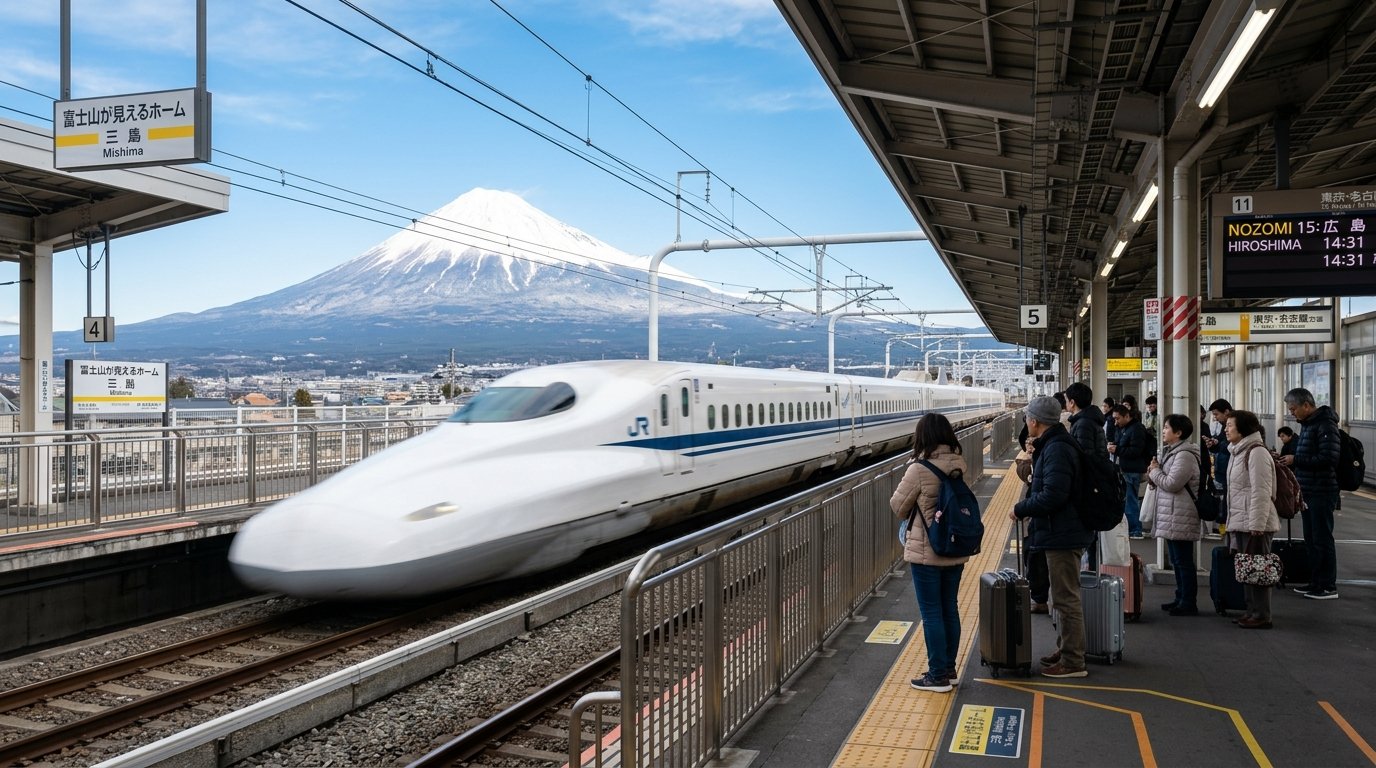
The Tokyo to Kyoto bullet train runs on the Tokaido Shinkansen line, operated by JR Central. This is the fastest, most reliable, and most comfortable way to make the journey from city center to city center. Trains depart constantly from Tokyo Station and Shinagawa Station, arriving directly into Kyoto Station.
There are three types of trains on this line, categorized by how many stops they make:
- Nozomi Shinkansen: The fastest option, taking about 2 hours and 15 minutes. It only stops at major stations like Shinagawa, Shin-Yokohama, and Nagoya. This is the primary choice for business travelers and tourists buying point-to-point tickets.
- Hikari Shinkansen: Takes about 2 hours and 40 minutes, making a few more stops than the Nozomi.
- Kodama Shinkansen: The slowest option, stopping at every single station along the route. It takes nearly 4 hours. It is rarely recommended unless you are getting off at a smaller station or have a very specific discount ticket.
Reserved vs unreserved seating explained
When buying a Shinkansen ticket, you must choose between a reserved and unreserved seat. Both types are found in Standard Class (Ordinary cars). There is also a first-class equivalent called the Green Car, which is exclusively reserved seating.
- Reserved seat: Guarantees you a specific seat on a specific train. It costs a few hundred yen more than unreserved, but it provides peace of mind, especially if you want to sit with travel companions or secure a window seat (ask for seat E to try and see Mount Fuji on the right side when heading west).
- Unreserved seat: Cheaper, but you must sit in specific unreserved cars (usually cars 1-3). You can take any train on the day your ticket is valid. If the unreserved cars are full, you will have to stand in the aisle or wait for the next train.
Japan Rail Pass relevance for Tokyo to Kyoto
The Japan Rail Pass covers the Tokyo to Kyoto route, but there is a major catch: the standard pass does not cover the Nozomi Shinkansen. If you have a JR Pass, you will need to ride the slightly slower Hikari train instead. If you want to ride the Nozomi with a JR Pass, you have to pay a hefty supplementary fee.
Since the national JR Pass increased in price significantly in late 2023, it is rarely cost-effective if you are only doing a standard round trip between Tokyo and Kyoto. You need a more extensive itinerary to justify the pass cost. See our breakdown on the Japan Rail Pass vs individual tickets for detailed calculations.
Domestic flight: Tokyo to Kyoto
Kyoto does not have its own airport. The closest major airport is Osaka Itami (ITM) or Kansai International (KIX). Flying from Tokyo (Haneda or Narita) to Osaka takes about an hour in the air. However, you must factor in the time and cost to get to the airport in Tokyo, arrive early for security, and then travel from Osaka to Kyoto (another hour or more by train or bus).
In almost all cases, the door-to-door time for a Tokyo to Kyoto flight is longer than taking the Shinkansen, and it is less convenient. The only time a flight makes sense is if you are arriving at Narita or Haneda from an international flight and immediately connecting to Osaka to head to Kyoto.
If you are exploring where to stay in Kyoto, ensure your hotel is easily accessible from the airport buses or trains if you choose to fly.
Overnight bus: Tokyo to Kyoto
For budget travelers, the Tokyo to Kyoto bus is an excellent way to save money on both transport and a night’s accommodation. The journey takes roughly 7 to 8 hours overnight.
Companies like Willer Express offer various seating configurations, ranging from basic 4-across seating to luxurious 2-across pods with privacy curtains and wide reclining seats. Prices range from ¥3,000 for standard buses booked in advance during off-peak times, up to ¥9,000 or more for premium seats on busy weekends.
While cheap, remember that you won’t get a full night’s sleep, and you will arrive in Kyoto very early in the morning, often hours before you can check into your accommodation.
Driving or private transfer
Renting a car to drive from Tokyo to Kyoto takes about 5.5 to 6.5 hours on the expressway. However, the tolls are extremely expensive, often exceeding ¥10,000, plus the cost of gas and the rental car itself. Parking in both Tokyo and Kyoto is notoriously expensive and scarce.
Private transfers exist but are incredibly expensive (often ¥80,000 or more) and take just as long as driving. For the vast majority of tourists, neither driving nor a private transfer makes sense compared to the ease and speed of the Shinkansen.
If you need transport from an airport or station to your hotel, check Kyoto station or airport transfers, which are practical for short distances.
Buying Shinkansen tickets
There are several ways to buy your Tokyo to Kyoto Shinkansen ticket:
- SmartEX: The official app and website (Smart-EX) by JR Central. You can book tickets online, select your seats, and link the reservation to a digital IC card (like Suica or Pasmo) on your phone, allowing you to tap through the gates.
- Ticket Machines: English-language machines are available at all JR stations. They are easy to use and accept international credit cards (though some foreign cards occasionally face pin issues).
- Ticket Offices (Midori no Madoguchi): The traditional staffed counters. They are great if you have complex questions, but lines can be very long.
If you are traveling during peak seasons (Golden Week in May, Obon in August, or New Year), it is strongly advised to book your reserved seats up to a month in advance.
Luggage considerations
Since May 2020, there have been strict rules regarding oversized luggage on the Tokaido Shinkansen. If your suitcase’s total dimensions (height + width + depth) are between 160cm and 250cm, it is classified as oversized luggage.
You must reserve a specific “seat with an oversized baggage area” at the back of the train car. If you bring an oversized bag without this specific reservation, you will be fined ¥1,000 on the train and forced to move your bag. Bags with total dimensions under 160cm (which includes most standard check-in suitcases) can be stored on the overhead racks.
If you don’t want to carry luggage at all, consider using Takuhaibin (luggage forwarding services) to send your bags from your hotel in Tokyo directly to your Kyoto accommodation. It usually costs around ¥2,000 per bag and takes 24 hours.
Families and groups
The Shinkansen seating is typically arranged in a 3-2 configuration. If you are traveling as a family or a group of four or more, you can rotate the seats so they face each other, creating a pod. Simply step on the pedal under the aisle seat and swivel the row around. Just make sure to return them to their original position before you disembark.
Children under 6 travel for free on the Shinkansen if they do not occupy their own reserved seat (they must sit on your lap). Children aged 6 to 11 pay half the adult fare.
Best option for most first-time visitors
Unless you are strictly bound by a tight budget, the Tokaido Shinkansen is the undisputed best way to travel from Tokyo to Kyoto. It is fast, clean, punctual, and drops you off right in the city center. For most travelers figuring out where to stay in Tokyo and Kyoto, the convenience of the Shinkansen easily justifies the price.
To stay connected while navigating transit, check Japan eSIM options or review our guide on the best eSIM for Japan.
5 Common mistakes on the Tokyo-Kyoto route
- Waiting in line at staffed counters: The lines at Midori no Madoguchi can take an hour. Use the automated machines or the SmartEX app instead.
- Ignoring the oversized luggage rules: If your bag is over 160cm in total dimensions, you must book the specific oversized baggage seat or face a fine.
- Boarding the wrong train type: If you have a JR Pass, you cannot take the Nozomi train without paying a large supplement. Double-check you are on a Hikari train.
- Not booking ahead during holidays: During Golden Week, Obon, and New Year, unreserved cars are packed, and reserved seats sell out weeks in advance.
- Forgetting to look for Mount Fuji: On a clear day, Mount Fuji is visible roughly 45 minutes after leaving Tokyo. Book seat E (or D and E for two people) to be on the correct side of the train.
FAQ
How much is the Shinkansen from Tokyo to Kyoto?
A one-way ticket on the Nozomi Shinkansen costs around ¥14,500 for a reserved seat and ¥13,320 for an unreserved seat. Prices vary slightly depending on the season (regular, peak, or off-peak).
How long is the bullet train from Tokyo to Kyoto?
The fastest train, the Nozomi, takes approximately 2 hours and 15 minutes. The Hikari takes about 2 hours and 40 minutes, and the Kodama takes almost 4 hours.
Can I use Suica for the Shinkansen?
You cannot simply tap a standard Suica card at the Shinkansen gates like a local train. However, if you register your Suica card with the SmartEX app and purchase a ticket through the app, you can link the reservation to your IC card and then tap to enter.
Is the JR Pass worth it for Tokyo to Kyoto?
If you are only doing a round trip between Tokyo and Kyoto, the national Japan Rail Pass is not worth the cost following the October 2023 price increase. It is cheaper to buy individual tickets.
Disclaimer: Train schedules, ticket prices, and luggage policies can change. Always verify the latest details with official providers such as JR Central before finalizing your travel plans.
Last checked: September 2026
Continue planning
Your most useful next steps
Move from reading to one clear travel decision.