
The practical takeaway
8 Cheap Flight Tricks Using Flexible Dates That Cut Airfare by 30–60% Finding cheap flights in 2026 is not about luck, browser tricks, or waiting for some imaginary “perfect booking day.” Travelers who consistently find cheap flights use smart travel strategies that…
8 Cheap Flight Tricks Using Flexible Dates That Cut Airfare by 30–60%

Finding cheap flights in 2026 is not about luck, browser tricks, or waiting for some imaginary “perfect booking day.” Travelers who consistently find cheap flights use smart travel strategies that work with airline pricing systems instead of fighting them.
Whether you are flying economy or business class, the fundamentals remain the same. Flexible dates, full-month search tools, alternative airports, and correct booking windows can reduce airfare by 30 to 60 percent. This guide explains exactly how experienced travelers find the cheapest flights today and which methods still work in 2026.
This is not a list of outdated myths. It is a practical, step-by-step breakdown of how to search, when to book, and which tools actually uncover lower fares.
Flexible Dates: The Most Reliable Way to Find Cheap Flights
If you want to find cheap flights consistently, flexibility matters more than any other factor. Airfare changes constantly due to demand, seat inventory, seasonality, and airline algorithms. Even shifting your trip by one day can unlock dramatically lower prices.
Instead of asking, “How much does it cost to fly on this date?” smart travelers ask, “Which dates are cheapest to fly?” That mindset shift alone can save hundreds.
Use Price-First Search Tools
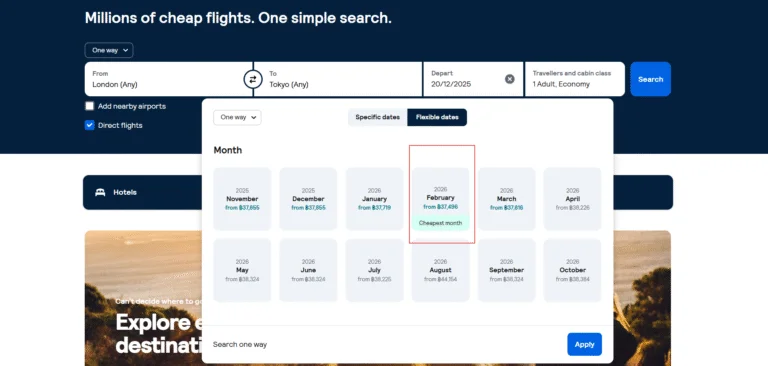
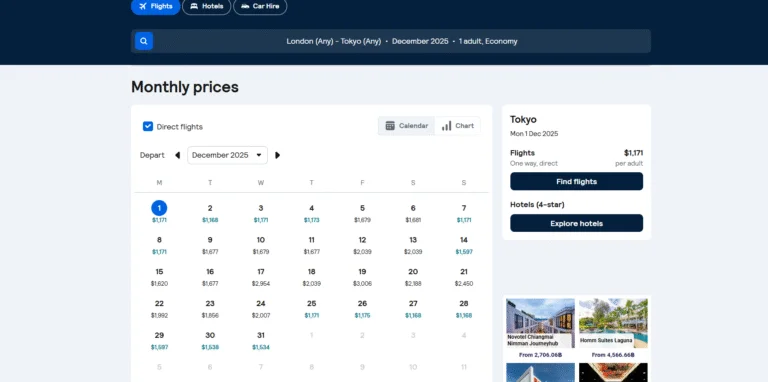
Do not start on airline websites. Airline sites show prices only for the exact dates you select, hiding broader price patterns.
Start with platforms that reveal price movement:
- Google Flights – Use the price graph and calendar view to scan cheaper days.
- Skyscanner – Use “Whole Month” and “Cheapest Month” views.
- Momondo – Compare multiple airlines and less obvious routes.
These tools immediately show which days airlines discount and which dates are artificially inflated.
Shift Dates by One or Two Days
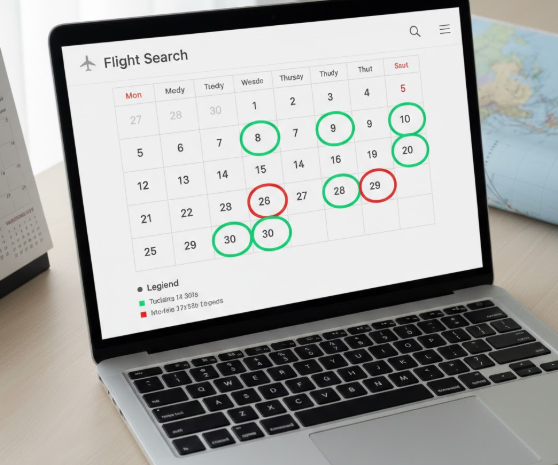
Moving your departure or return date by just one or two days can reduce airfare significantly. This is especially true for long-haul routes to the United States, Europe, and Japan.
Midweek departures often cost far less than weekend flights. Fare calendars make these differences obvious when you zoom out beyond fixed dates.
Target Shoulder and Off-Peak Seasons
Peak travel periods come with premium pricing. Shoulder seasons, such as spring and fall, often deliver 40 to 50 percent lower fares with better travel conditions.
Traveling outside school holidays, major festivals, and summer peaks remains one of the simplest ways to find cheap flights without any advanced tricks.
Stay Open to Alternative Destinations
If your goal is travel value rather than a specific city, flexibility unlocks massive savings. When Europe is expensive, Southeast Asia or South America may be heavily discounted. When Tokyo spikes, Osaka or Fukuoka may drop.
Price-first searches reveal opportunities most travelers never see.
Fixed Dates: How to Find Cheap Flights When Flexibility Is Limited
Sometimes flexibility is not an option. Weddings, conferences, school schedules, and work commitments lock your travel dates. When that happens, timing and monitoring become your most important tools.
Book Within the “Goldilocks” Window
Booking too early or too late usually costs more. Airlines release schedules around ten to eleven months in advance, but early fares are often inflated.
Based on historical pricing patterns:
- Domestic flights are usually cheapest 1 to 3 months before departure.
- International flights perform best 2 to 8 months in advance.
For peak seasons or major holidays, add extra lead time. Prices tend to rise sharply in the final weeks before departure.
Set Fare Alerts Immediately
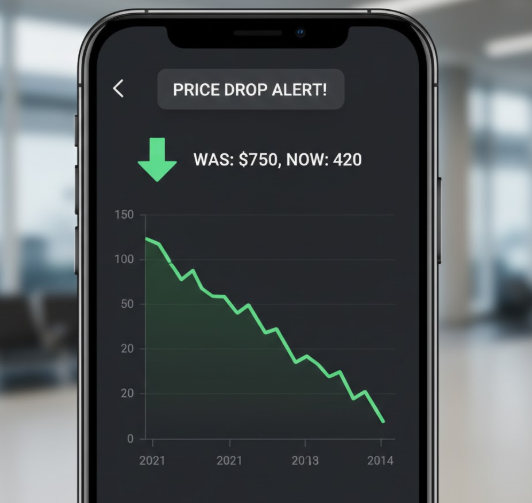
If your dates are fixed, monitoring matters more than searching repeatedly. Set price alerts on Google Flights, Skyscanner, or Kayak as soon as your trip is confirmed.
These alerts notify you when fares drop so you can book at the right moment instead of guessing.
Book Now, Rebook If Prices Drop
Many airlines have eliminated change fees on standard economy tickets. This allows a smart strategy: book a reasonable fare when you see it, then monitor prices.
If the fare drops later, rebook and keep the difference as a travel credit. This approach removes the fear of booking “too early” while protecting you from price increases.
Avoid basic economy tickets if you plan to use this strategy, as they usually restrict changes.
Fly on Cheaper Days and Off-Peak Times

Not all days are priced equally. Airline demand patterns remain predictable even in 2026.
Cheapest Days to Fly
Tuesdays, Wednesdays, and Saturdays are typically the cheapest days to fly. These days attract fewer business travelers and leisure weekend flyers.
Fridays and Sundays are usually the most expensive due to high demand.
Early Morning and Red-Eye Flights
Flights departing early in the morning or late at night are often cheaper because they are less convenient. These flights also experience fewer delays, making them a surprisingly practical option.
Avoid Peak Holiday Dates
Flying just before or after major holidays almost guarantees higher prices. If possible, fly on the holiday itself, which is often much cheaper than surrounding dates.
Booking Windows and Price Cycles in 2026
Airlines use dynamic pricing systems that adjust fares constantly based on demand and seat availability. There is no single “best day” to book, but there are patterns.
Do Not Book Too Early
Flights often start expensive when schedules first open. Airlines know early planners are less price-sensitive.
Do Not Wait Too Long
Last-minute deals are rare for popular routes. Prices usually climb in the final weeks as airlines target urgent travelers.
Use Price History Tools
Google Flights shows whether a fare is low, typical, or high compared to historical data. This context helps you decide whether to book or wait without guessing.
Cheapest Flights With Flexible Dates: How the Trick Actually Works
If you want to find the cheapest flexible flights, you must stop searching exact dates and start searching full months. Airfare fluctuates constantly, and airlines rely on travelers locking themselves into fixed dates.
Searching a full month reveals:
- The cheapest days airlines quietly discount
- Hidden midweek price drops
- Unadvertised route sales
For long-haul routes to the United States, Europe, and Japan, a one-day shift can reduce prices by 30 to 60 percent.
Why Full-Month Searches Beat Airline Websites
Airline websites hide price patterns by design. They show only the dates you request. Full-month tools expose the entire pricing landscape in seconds.
If you search the whole month instead of one date, you consistently pay less.
Let AI Do the Heavy Lifting
Manually comparing dates, airports, one-way combinations, and open-jaw routes takes time. This is where automation matters.
The FlyFono AI Trip Planner simplifies the entire process by analyzing full calendars, nearby airports, one-way combinations, and open-jaw routes in one place.
The planner helps you:
- Identify the cheapest days to fly
- Compare alternative airports automatically
- Combine one-way and open-jaw routes
- Avoid inefficient layovers
If your goal is to find cheap flights quickly without endless searching, using AI removes most of the friction.
Finding cheap flights in 2026 is not about luck, browser tricks, or waiting for some imaginary “perfect booking day.” Travelers who consistently find cheap flights use smart travel strategies that work with airline pricing systems instead of fighting them.
Whether you are flying economy or business class, the fundamentals remain the same. Flexible dates, full-month search tools, alternative airports, and correct booking windows can reduce airfare by 30 to 60 percent. This guide explains exactly how experienced travelers find the cheapest flights today and which methods still work in 2026.
This is not a list of outdated myths. It is a practical, step-by-step breakdown of how to search, when to book, and which tools actually uncover lower fares.
Open-Jaw Flights: The Underused Move That Finds Cheap Flights
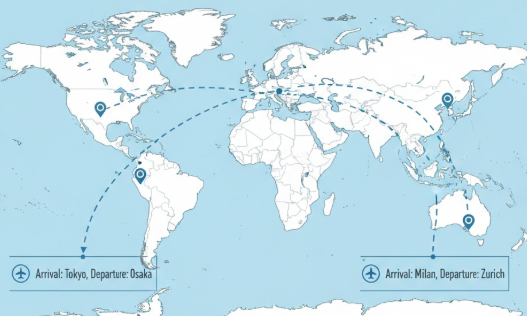
Open-jaw itineraries sound fancy, but the concept is simple: you fly into one city and return from another. This often produces cheaper fares than a standard round-trip because taxes, competition, and airline pricing differ by city. It also saves time because you stop backtracking like a confused tourist dragging a suitcase through the same train station twice.
Japan example: Fly into Tokyo and return from Osaka (connect the cities by Shinkansen).
Europe example: Fly into Milan and return from Zurich (connect by train).
USA example: Fly into Los Angeles and return from San Francisco (drive or take a short hop).
Open-jaw routes work best when you are visiting multiple cities anyway. You reduce wasted transit time and often unlock cheaper fares at the same time. That is the kind of multitasking your bank account appreciates.

Break Round-Trips Into Two One-Way Tickets (Yes, It Still Works)
Many travelers default to round-trips because it feels “correct.” Airlines love that. Round-trips lock you into one airline and one set of pricing rules. Two one-way tickets can open more options, more carriers, and more fare combinations.
Example strategy:
- Bangkok → New York (JFK) on Airline A
- New York → Bangkok via Tokyo or Seoul on Airline B
This allows you to mix deals, use different hubs, and avoid inflated return fares. It is also how people accidentally stumble into better itineraries and then act like they are a “travel hacker.”
Alternative Airports: The Fastest Way to Find Cheap Flights
If you do only one thing from this guide, do this. Comparing alternative airports often saves more money than any other tactic, because airports within the same region can have wildly different pricing due to competition, airline presence, and taxes.
United States
- New York: JFK / EWR / LGA
- Washington DC: DCA / IAD
- California: LAX / SFO / SAN
Europe
- London: Heathrow vs Gatwick
- Paris: CDG vs Orly
- Amsterdam: Schiphol often has competitive EU pricing
Japan
- Tokyo: Narita vs Haneda
- Osaka: Kansai
- Other money-savers: Fukuoka, Sapporo
Nearby airports can be $100 to $300 cheaper for the same week. If you refuse to check them, you are basically donating money to the airline industry. They do not need your donation.
Combine Flights and Trains to Unlock Cheaper Gateways
Sometimes the expensive part is not the trip. It is your insistence on landing in the “main” airport. Many cities are easy to reach by train from cheaper gateways, which means you can use a cheaper airport without sacrificing the destination.
Europe
- Fly to Brussels, take a train to Paris
- Fly to Milan, take a train to Venice
- Fly to Prague, take a train to Vienna
Japan
- Fly to Fukuoka, train to Hiroshima
- Fly to Tokyo, train to Nagoya
This works because airports are priced strategically. Trains give you flexibility, and flexibility is where cheap flights live.
“Anywhere” Searches: When You Want a Deal, Not a Destination
If your goal is a cheap international trip rather than a specific city, use “anywhere” searches to let prices guide you. This is how people end up in unexpectedly great places while their friends pay double to go somewhere overcrowded and overpriced.
Use Skyscanner’s “Everywhere” or Google Flights Explore to see the cheapest destinations from your airport. For Google Flights, the Explore map can reveal seasonal dips that do not show up when you search a fixed city.
Try it here: Use Google Flights to scan full-month price patterns and compare routes quickly.
Fare Alerts and Deal Newsletters: Let the Discounts Come to You
Searching five times a day is not a strategy. It is anxiety with Wi-Fi. Set alerts and let tools notify you when prices drop.
- Google Flights: tracking + price history
- Skyscanner: alerts by route and month
- Kayak: alerts + trend indicators
Deal newsletters are also useful if you have flexible timing. Services like Going (formerly Scott’s Cheap Flights) and Secret Flying look for unusually low fares and mistake fares.
Useful resources: Going for curated deals and Skyscanner for flexible month searches and “Everywhere” results.
Budget Airlines: Cheap Flights, With Conditions
Budget airlines can produce absurdly low fares, especially on short routes. The catch is that you pay for extras, and the fees can pile up if you are not careful. If you travel light and do not treat seat selection like a human right, budget airlines can be a smart move.
Always compare the total cost including baggage fees. A “cheap” fare that becomes expensive after luggage and seat fees is not a deal. It is marketing.
For long-haul, newer budget carriers can sometimes offer significantly lower prices than legacy airlines, but comfort and flexibility may be limited. Decide what matters more: saving money, or arriving like a functional human being.
Advanced Hacks: Hidden-City Ticketing and Throwaway Returns (Use Caution)
Some travelers use tactics like hidden-city ticketing (getting off at the layover city) or booking round-trips and skipping the return. These can sometimes create cheaper fares because airline pricing can be irrational.
However, airlines forbid hidden-city behavior in their policies and may penalize frequent use. If you ever use it, do it as a one-way and travel with carry-on only. Checked baggage goes to the ticketed final destination, and your suitcase will not magically teleport to your real plan.
If you want a tool that finds these routes, Skiplagged is well-known for it. Use at your own risk.
Reference tool: Skiplagged (use cautiously and understand airline rules).
Myths to Ignore When Booking Cheap Flights
Myth: “Incognito mode gets cheaper fares”
Incognito mode does not reset airline pricing. Prices change because inventory changes and demand shifts. If a fare rises while you are browsing, it is usually because the lower fare bucket sold out or the algorithm adjusted. Incognito is for privacy, not for magically unlocking cheap flights.
Myth: “There is one best day to book”
There is no universal best day. Airfare pricing is dynamic and route-specific. Your best move is to track prices early, watch patterns, and book when the fare is clearly in a low range for that route.
Myth: “Last-minute is always cheaper”
Last-minute deals are not a dependable strategy. For popular routes, prices typically climb close to departure. Waiting is a gamble, and the airline usually wins.
Use the FlyFono AI Trip Planner to Find Cheap Flights Faster
If you want to skip the manual comparisons, the FlyFono AI Trip Planner can help you build a smarter flight plan by suggesting cheaper date ranges, nearby airports, and better routing options.
Instead of doing ten tabs of searches, you can use it to quickly narrow down:
- Cheapest travel days inside your date window
- Alternative airports that reduce fare costs
- Open-jaw and one-way combinations
- Cleaner itineraries that avoid ugly layovers
If your goal is cheap flights without turning flight search into a second job, using AI is the practical choice.
Final Takeaway: The Real Formula for Cheap Flights in 2026
Finding cheap flights is not magic. It is method. If you want cheaper fares, do what smart travelers do:
- Search full months, not single dates
- Compare alternative airports
- Use one-way and open-jaw routes where they make sense
- Combine flights and trains to access cheaper gateways
- Set fare alerts and let deals come to you
- Use tools like Google Flights and Skyscanner to see price patterns
Most people overpay because they search like it is 2012. Do not be most people.
If you want more hotel pricing tactics, read: How Smart People Secretly Book the Cheapest Branded Hotels.
What is the best way to find cheap flights in 2026?
The best way to find cheap flights in 2026 is to search full months instead of fixed dates, compare alternative airports, and use price-tracking tools like Google Flights and Skyscanner. Travelers who stay flexible on dates and routing consistently pay 30–60 percent less than those who search single days.
Do flexible dates really make flights cheaper?
Yes. Flexible dates are the single most reliable method to find cheap flights. Airline prices fluctuate daily, and shifting your trip by even one day can unlock significantly lower fares, especially on long-haul routes to the United States, Europe, and Japan.
When is the cheapest time to book flights?
There is no universal “best day,” but most cheap flights appear within a booking window. For domestic trips, that window is usually 1–3 months before departure. For international flights, 2–8 months in advance is ideal. Prices often rise sharply in the final weeks before travel.
Are Tuesday flights still cheaper than weekends?
Generally, yes. Tuesdays, Wednesdays, and Saturdays are often cheaper because demand is lower. Fridays and Sundays tend to be the most expensive days due to business and weekend travel demand. Flying midweek remains one of the easiest ways to reduce airfare.
Is Google Flights good for finding cheap flights?
Google Flights is one of the best tools for finding cheap flights because it shows price history, fare calendars, and flexible date comparisons. It also allows travelers to track routes and receive alerts when prices drop.
Do airline prices change if I search too much?
No. The idea that airlines raise prices because of repeated searches is a myth. Airline pricing changes due to demand, inventory, and algorithm updates, not your browser cookies. Incognito mode does not unlock cheaper flights.
Is it cheaper to buy one-way tickets instead of round-trip?
Sometimes, yes. Booking two one-way tickets can be cheaper than a round-trip because it allows you to mix airlines, routes, and sale fares. This strategy is especially effective for international travel and open-jaw itineraries.
What are open-jaw flights and do they save money?
An open-jaw flight means flying into one city and returning from another. Open-jaw routes often save money because airport taxes and airline competition differ by city. They are particularly effective in Europe, Japan, and the United States.
Do alternative airports really make flights cheaper?
Yes. Comparing nearby airports can save $100–300 or more on the same trip. Major cities often have multiple airports with different pricing due to airline competition and operating costs. Always check all nearby options before booking.
Are budget airlines the cheapest option?
Budget airlines can offer very cheap base fares, but extra fees for baggage, seats, and meals can add up. They work best for short trips and travelers who pack light. Always compare the total cost, not just the headline price.
Are last-minute flights cheaper?
Usually not. Last-minute deals are rare for popular routes. Airlines typically increase prices close to departure because urgent travelers are willing to pay more. Waiting until the last minute is a high-risk strategy that often backfires.
Is hidden-city ticketing legal?
Hidden-city ticketing is not illegal, but it violates airline policies. Airlines may penalize travelers who use it frequently. If used at all, it should be done cautiously, with carry-on luggage only, and without linking frequent flyer accounts.
Can AI tools help find cheap flights?
Yes. AI-based planners can analyze full calendars, nearby airports, and routing combinations faster than manual searches. Tools like the FlyFono AI Trip Planner help identify cheaper dates and routes without spending hours comparing options.
Do cheap flight deals still exist in 2026?
Yes. Cheap flights still exist in 2026, but they reward flexibility and smart searching. Travelers who use full-month searches, fare alerts, and alternative airports consistently find deals that others miss.
Continue planning
Your most useful next steps
Move from reading to one clear travel decision.
Pingback: Best Luxury Places to Visit for New Year’s 2026 (Global List) - FlyFono
Pingback: What Airport Officials Really Check Before Giving You a Boarding Pass (2026 Travel Guide) - FlyFono
Pingback: Everest Base Camp Trek Itinerary 2026: The Ultimate and Essential Day-by-Day Guide - FlyFono
Pingback: Best Places to Go in December (2025 & 2026 Guide) - FlyFono
Pingback: Things to Do in Phu Quoc (2025 & 2026 Guide) - FlyFono
Pingback: Singapore and Malaysia 7-Day Itinerary: The Ultimate Travel Guide - FlyFono
Pingback: Safe Solo Trip Destinations in India for Girls: The Ultimate Guide - FlyFono
Pingback: Coron vs El Nido: The Ultimate Honest Showdown (Which Is Better?)Coron vs El Nido - FlyFono
Pingback: - FlyFono
Pingback: - FlyFono
Pingback: 9 Essential Hong Kong Disneyland Tips for a Perfect Visit (Honest, Must-Read Guide) - FlyFono
Pingback: Chiang Mai Lantern Festival 2026: The Only Honest Guide You Need (Free vs Paid + Lamphun Free Event) - FlyFono
Pingback: 15 Free Family Activities in Singapore: The Best Budget-Friendly Things to Do With Kids - FlyFono
Pingback: Indian Food in Thailand (2026): Where Indians Can Actually Find Real Desi Food — From Bangkok to Phuket & Even the Airports - FlyFono
Pingback: Best Places to Visit in January 2026: 25 Incredible Destinations for Perfect Weather & Great Value - FlyFono
Pingback: 7 Day Trips from Hanoi That Are Actually Worth Your Time (No Tourist Traps & No Regrets) - FlyFono
Pingback: Bangkok vs Kuala Lumpur vs Singapore: Which City Is Best for First-Time Travelers? - FlyFono
Pingback: 17 Cheap Flights from Thailand: Best Nearby Countries, Airlines, and Smart Open-Jaw Hacks - FlyFono
Pingback: Best Places to Travel in February 2026: Top 10 Trending Destinations (With 7-Day Budget, Mid-Range, and Luxury Itineraries) - FlyFono
Pingback: Hua Hin vs Pattaya: 17 Brutally Useful Differences (2026 Guide) - FlyFono
Pingback: Japan Airlines Free Flights: What Is Real, What Is Fake, and How to Actually Book (2025 Guide) - FlyFono
Pingback: 7 Days Kuala Lumpur Itinerary With Day Trips (2026 Complete Guide) - FlyFono
Pingback: Riyadh vs Dubai (2026): The Ultimate, Brutally Honest City Comparison - FlyFono
Pingback: 7 Brutally Useful Tips: Guide for Indians to Visit Australia (Visa, Cost & Food) - FlyFono
Pingback: 9 Smart Ways to Stay in Dubai on a Budget (Without Regret) - FlyFono
Pingback: The Osaka vs Tokyo debate: Why Americans Are Suddenly Choosing Osaka Instead of Tokyo in 2026 - FlyFono
Pingback: Are Power Banks Allowed in Flights? What Airlines Actually Allow in 2026 - FlyFono
Pingback: Solo Travel in Asia: 4 Best Cities First-Time Travelers Love - FlyFono
Pingback: Inbound Tourism to Australia: 5 Reasons Visitors Are Avoiding Major Cities - FlyFono
Pingback: Revenge Travel Is Dead: 7 Reasons Purpose Travel Is Winning - FlyFono
Pingback: Saudi Arabia Tourism: 7 Powerful Reasons Asia Is Suddenly Interested - FlyFono
Pingback: Winter Storm Travel Disruption: 11 Brutal Impacts on Flights, Airports & Plans - FlyFono
Pingback: UK ETA Requirement: 7 Costly Mistakes That Can Get You Denied Boarding - FlyFono
Pingback: China Visa-Free Travel for Britons: 7 Powerful Rules You Must Know Before Booking - FlyFono