
The practical takeaway
Compare 4 ways from Hong Kong to Macau: TurboJet and Cotai Water Jet ferries, cross-border buses via HZMB, self-drive across the bridge, and helicopter. Covers times, fares, terminals, and immigration.
If you are planning a comprehensive trip to East Asia or simply exploring the vibrant Pearl River Delta region, knowing exactly how to travel from Hong Kong to Macau is an essential piece of knowledge for putting together an incredible itinerary. These two Special Administrative Regions (SARs) of China sit roughly 60 kilometers apart across the mouth of the Pearl River. Despite their close geographical proximity, they offer starkly contrasting experiences. Hong Kong is a towering, fast-paced financial hub with British colonial influences, while Macau is a fascinating blend of Portuguese heritage, laid-back coastal vibes, and glittering, world-class casino resorts that rival Las Vegas. The journey between these two spectacular destinations takes anywhere from 15 minutes to over 2 hours, depending entirely on your chosen mode of transport, your budget, and where exactly your hotel is located.
The main search question travelers have is: “What is the best way to get from Hong Kong to Macau?” The direct answer: For most visitors, taking the high-speed ferry (operated by TurboJet or Cotai Water Jet) remains the most convenient, comfortable, and direct method, dropping you right into the heart of Macau or Taipa in about 60 minutes. However, if you are looking for the cheapest route, the cross-border shuttle bus over the breathtaking Hong Kong-Zhuhai-Macau Bridge (HZMB) is your best bet, while the Sky Shuttle helicopter service offers the ultimate luxury and speed for those with a higher budget.
Quick Answer: Hong Kong to Macau Travel Summary
1. High-Speed Ferry (TurboJet & Cotai Water Jet): The undisputed most popular and convenient option for tourists and locals alike. The journey takes about 60 minutes from downtown Hong Kong (either Sheung Wan on Hong Kong Island or Tsim Sha Tsui in Kowloon) directly to Macau. Standard economy tickets cost around HKD 175 to HKD 220 depending on the time of day and whether it is a weekend.
2. Cross-Border Bus via HZMB: The undisputed cheapest option. The drive across the bridge takes about 40 to 45 minutes, but getting to the port and clearing immigration adds significant time. The bus ticket itself costs around HKD 65.
3. Driving (Self-Drive across HZMB): Not recommended for typical tourists. Requires special permits, dual license plates, and cross-border insurance. Hiring a private chauffeur with these permits is an alternative for extreme comfort, costing around HKD 3,000.
4. Helicopter (Sky Shuttle): The fastest and most luxurious method. A thrilling 15-minute flight across the delta. Costs a premium of around HKD 4,300 per person.
Some links in this guide are affiliate links. FlyFono may earn a commission if you book through them, at no extra cost to you. Recommendations are based on practical relevance, not commission.
Before you begin planning your seamless transit across the Pearl River Delta, make sure you have solid connectivity on your smartphone. Having access to Google Maps, translation apps, and ride-hailing services is crucial. We highly recommend picking up a reliable data plan from Saily eSIM. If you are planning a wider tour across the continent, you can also read our comprehensive guide on the best eSIM for Japan, Thailand, and Southeast Asia.
1. High-Speed Ferry: The Most Popular and Convenient Option
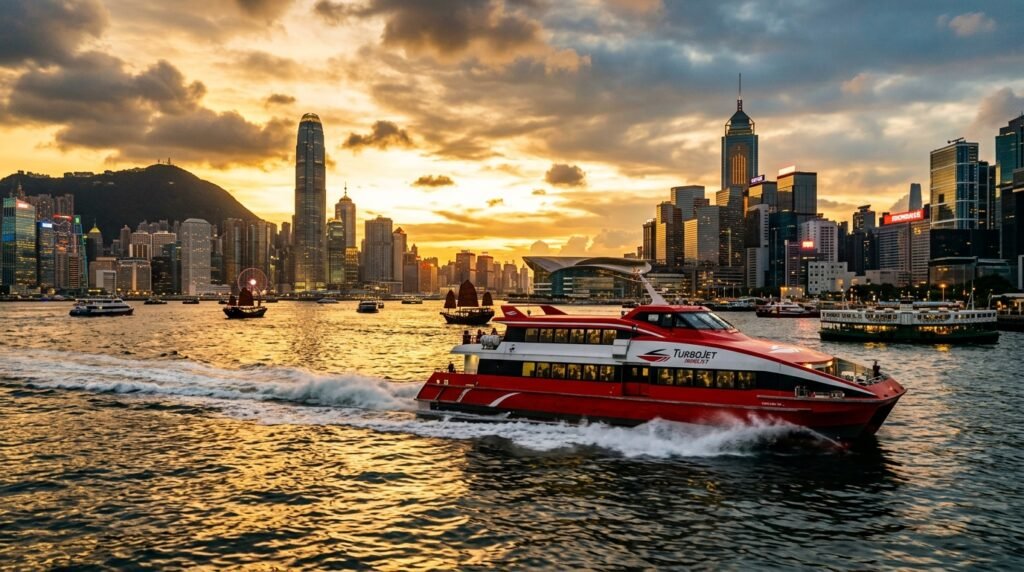
For decades, before the completion of the mega-bridge, the high-speed ferry was practically the only viable way for tourists to travel between Hong Kong and Macau. Today, it remains the quintessential method of travel. It strikes the perfect balance between cost, speed, and comfort. The two main operators dominating these waters are TurboJet (distinguished by their bright red vessels) and Cotai Water Jet (known for their sleek blue catamarans). Both companies operate modern, air-conditioned fleets that slice through the waves at impressive speeds, minimizing seasickness and ensuring a smooth, enjoyable ride.
Ferry seating is generally divided into Economy Class and Super Class (or VIP/First Class). Economy is perfectly adequate for the one-hour journey, offering comfortable, airline-style seating. Super Class offers wider seats, priority disembarkation, complimentary snacks and beverages, and access to a premium lounge at the terminal before departure.
TurboJet: Best for the Macau Peninsula
TurboJet primarily connects the Hong Kong Macau Ferry Terminal (located conveniently in the Shun Tak Centre in Sheung Wan, Hong Kong Island) to the Macau Outer Harbour Ferry Terminal. This specific route is ideal if your itinerary involves exploring the historic center of Macau. This area includes iconic UNESCO World Heritage sites like the ruins of St. Paul’s, Senado Square, the A-Ma Temple, and older, classic casino establishments like the Grand Lisboa and the Wynn Macau.
TurboJet also operates sailings from the China Ferry Terminal located in Tsim Sha Tsui (Kowloon). This is incredibly convenient if your hotel is situated on the Kowloon side of Victoria Harbour, saving you an MTR trip to Hong Kong Island. Sailing time is approximately 55 to 60 minutes. Ferries run frequently, typically every 15 to 30 minutes during peak daylight hours. Night services are also available, though they come with a slight surcharge. You can easily and securely book your ferry tickets in advance via Klook to avoid long queues at the ticketing counters, which can get extremely busy during weekends and public holidays.
Cotai Water Jet: Best for Taipa and the Mega Casinos
If your ultimate destination is the glittering Cotai Strip—a massive expanse of reclaimed land home to mega-resorts like The Venetian Macao, The Parisian Macao, Studio City, and Galaxy Macau—then Cotai Water Jet is undoubtedly your best option. These striking blue ferries depart primarily from the Hong Kong Macau Ferry Terminal (Sheung Wan) and arrive directly at the Macau Taipa Ferry Terminal. The journey takes about 60 minutes.
Choosing Cotai Water Jet over TurboJet in this scenario saves you the hassle of taking a long, potentially traffic-heavy shuttle bus or taxi ride from the Macau Peninsula all the way down to the Cotai Strip. Similar to TurboJet, luggage allowances apply. Usually, one piece of carry-on hand baggage is free, while larger or heavier suitcases must be officially checked in at the terminal for an additional fee before boarding.
2. Cross-Border Bus via HZMB: The Budget-Friendly Route
The official opening of the Hong Kong-Zhuhai-Macau Bridge (HZMB) in 2018 revolutionized travel and logistics in the Greater Bay Area. At 55 kilometers long, the HZMB is a modern engineering marvel, featuring massive cable-stayed spans and an undersea tunnel. Utilizing the cross-border shuttle buses—often affectionately referred to as the “Golden Buses” due to their distinct gold coloring—is currently the most economical way to reach Macau from Hong Kong.
To take this budget-friendly route, you must first travel to the Hong Kong Port of the HZMB. This port is located on an artificial island adjacent to Hong Kong International Airport on Lantau Island. You can reach the port via various city buses (the “A” and “B” routes) or by taking the Airport Express train and transferring. If you are coming directly to Macau right after landing in Hong Kong, it’s incredibly convenient as it is very close to the airport. For more context on navigating airport transport, check out our guide on getting from Hong Kong Airport to the city.
Once you arrive at the massive Hong Kong Port building, you will pass through Hong Kong departure immigration, purchase a shuttle bus ticket at the automated kiosks or manned counters (costing around HKD 65 for adults), and board the next available Golden Bus. The buses run constantly, 24 hours a day, 7 days a week. The drive itself across the bridge is smooth and takes roughly 40 to 45 minutes, offering unique views of the ocean and passing ships.
You will eventually arrive at the Macau Port (also located on an artificial island), where you disembark, go through Macau arrival immigration, and from there, you can catch local public buses, taxis, or integrated resort casino shuttle buses to your final destination in either the Peninsula or Taipa. While this is undeniably the cheapest option available, it does require multiple transfers if you are starting your journey from a hotel in central Hong Kong. It is highly recommended for budget backpackers, groups looking to save cash, or those travelers who are prone to severe seasickness and wish to avoid the boats entirely.
3. Driving: Self-Drive Across the HZMB
Driving from Hong Kong to Macau across the monumental HZMB is technically possible, but it is accompanied by a sheer labyrinth of bureaucratic requirements that make it impractical for the average visitor. Unlike driving across state lines in the US or open borders in the European Schengen Area, you cannot simply rent a standard car at the airport and drive across the bridge.
To legally drive a private vehicle across the bridge, the vehicle must possess special, highly restricted cross-boundary vehicle quotas and dual license plates (displaying both Hong Kong and Macau/Mainland China registrations). Additionally, drivers must apply for specific permits from multiple government departments and ensure their car insurance explicitly covers all three territories involved (Hong Kong, Macau, and the Mainland Chinese waters the bridge passes through). Furthermore, there is a fascinating engineering feature where drivers must switch from driving on the left side of the road (Hong Kong/Macau style) to the right side (Mainland China style) at a specifically designed merge point on the bridge.
For the vast majority of tourists, expats, and casual visitors, self-driving is simply not a viable or practical option. However, if you prefer the extreme comfort, privacy, and convenience of a private car without the immense hassle of driving yourself, you can hire private cross-border transfer services. These companies provide luxury minivans (like the Toyota Alphard) with professional drivers who already hold all the necessary permits and plates. This offers seamless door-to-door convenience—you won’t even need to exit the vehicle at immigration—but it comes at a premium price, usually ranging from HKD 2,500 to HKD 4,000 per trip, depending on the vehicle type and destination.
4. Helicopter (Sky Shuttle): The Ultimate Luxury Experience
For those who value time above all else, business executives with tight schedules, or travelers looking to add a spectacular, memorable, and highly photogenic experience to their itinerary, the Sky Shuttle helicopter service is absolutely unparalleled. Operating primarily between the Hong Kong Macau Ferry Terminal (Sheung Wan) and the Macau Outer Harbour Ferry Terminal, the helicopter turns a standard 60-minute boat ride into a breathtaking 15-minute aerial journey.
During the incredibly short and smooth flight, passengers are treated to stunning panoramic views of Victoria Harbour, the lush green islands of the South China Sea, the HZMB bridge snaking across the water below, and the sprawling skylines of both iconic cities. Flights depart approximately every 30 minutes during standard operational hours (usually from early morning to late evening).
Prices are steep, as one would expect for this level of luxury, typically hovering around HKD 4,300 to HKD 4,500 per person for a single one-way ticket, plus applicable taxes and holiday fees. The Sky Shuttle experience includes access to exclusive VIP passenger lounges with complimentary food and beverages prior to departure. Luggage is tightly restricted due to weight limits; each passenger is typically allowed one piece of check-in baggage up to 16kg, with any excess luggage incurring significant fees. It’s the very definition of traveling in style and arriving like a VIP.
Immigration and Visa Requirements Explained
Traveling between Hong Kong and Macau involves crossing an official boundary, meaning international-style immigration and customs procedures are strictly enforced on both sides, regardless of how you travel.
Exiting Hong Kong: Whether you travel by ferry, bridge bus, or helicopter, you must first clear Hong Kong departure immigration. This is usually a swift and efficient process. If you hold a Hong Kong Identity Card or have registered for the automated e-Channel service as a frequent visitor, you can simply scan your passport and fingerprint. Otherwise, you will queue for a manned counter. Ensure you have your passport and your initial Hong Kong arrival slip (the small white piece of paper printed when you first entered Hong Kong) handy.
Entering Macau: Upon arriving at any Macau port or ferry terminal, you must go through Macau arrival immigration. Macau relies heavily on tourism and is exceptionally welcoming to international visitors. Passport holders from over 70 countries—including the United States, Canada, Australia, New Zealand, the United Kingdom, Japan, South Korea, and most European Union nations—can enter Macau completely visa-free for tourism purposes. The permitted length of stay ranges widely from 14 days up to 90 days, depending entirely on your specific nationality.
Visitors holding passports from countries not currently on the visa-free list must apply for a visa. While visas upon arrival are available at the border for some nationalities, it is highly recommended to check the official Macau Public Security Police Force website well before your trip to ensure full compliance and avoid being turned back at the border. Crucially, remember that if you plan to return to Hong Kong after your Macau trip, you must hold a valid multiple-entry visa for Hong Kong (this only applies if your nationality requires a visa for Hong Kong in the first place).
Terminal Logistics, Luggage, and Casino Shuttle Buses
Understanding the layout of the various terminals is crucial to a stress-free journey.
Hong Kong Side:
- Hong Kong Macau Ferry Terminal: Located in the Shun Tak Centre in Sheung Wan. It is directly connected to the Sheung Wan MTR station (Island Line). This is the busiest and most popular terminal. It features numerous restaurants, currency exchanges, and shops. If you need a hotel nearby to ensure an easy departure, read our guide on where to stay in Hong Kong to find excellent accommodations close to Sheung Wan or Central.
- China Ferry Terminal: Located in Tsim Sha Tsui, Kowloon. Best if you are staying in the bustling Kowloon area, near Nathan Road or the Victoria Harbour waterfront.
- Hong Kong Port (HZMB): Located on an artificial island near the airport on Lantau Island. Accessible by various city buses and the Airport Express.
Macau Side:
- Macau Outer Harbour Ferry Terminal: Closest to the historic center, the Macau Tower, and the older, iconic casinos on the Macau Peninsula.
- Macau Taipa Ferry Terminal: Located near the Macau International Airport. It is the absolute closest terminal to the massive, sprawling mega-resorts on the Cotai Strip.
- Macau Port (HZMB): Located on another massive artificial island. Connected to both the Peninsula and Taipa via a network of public buses and taxis.
One of the absolute best perks of arriving in Macau as a tourist is the extensive network of free, brightly colored casino shuttle buses. Regardless of which ferry terminal or port you arrive at, you will exit customs and immediately find rows of these buses waiting outside in designated bays. These buses are completely free of charge and will take you directly to the major hotels and casinos. You do not even need to have a hotel reservation or be a gambler to ride them. Simply find the bus with the logo of the casino nearest your intended destination and hop on. They run frequently and are air-conditioned. If you’re booking accommodations for your trip, be sure to check out amazing deals at Trip.com for the absolute best hotel rates in both Hong Kong and Macau.
Comparison Table: Hong Kong to Macau Transport
| Transport Option | Est. Cost (Adult One-Way) | Travel Time | Best For |
|---|---|---|---|
| High-Speed Ferry (TurboJet/Cotai) | HKD 175 – 220 | 60 mins | Overall convenience, direct city-to-city access, comfort |
| HZMB Bus (Golden Bus) | HKD 65 | 40-45 mins (bridge driving time only) | Budget backpackers, groups, 24/7 access needs |
| Private Car Transfer via HZMB | HKD 2,500 – 4,000 | 60 – 80 mins (door-to-door) | Families with kids, extreme comfort, heavy luggage |
| Helicopter (Sky Shuttle) | ~ HKD 4,300 | 15 mins | Luxury travelers, executives, incredible scenic views |
Best Option by Traveller Type
For the First-Timer: The High-Speed Ferry is a complete no-brainer. It is straightforward, incredibly reliable, easy to book, and drops you in areas that are very well connected to all tourist infrastructure. It offers the classic, quintessential Hong Kong-Macau travel experience that millions enjoy every year.
For the Budget Backpacker: The HZMB cross-border bus is your undisputed champion. While navigating public transport to get to the port takes a bit of effort and time, the financial savings are substantial, especially if you are traveling round-trip on a tight budget.
For the Family with Heavy Luggage and Children: Consider either taking an Uber or taxi to the ferry terminal and utilizing their official check-in luggage services, or, if your budget permits, seriously consider a private cross-border transfer. Navigating public city buses to the HZMB port with massive suitcases, strollers, and restless kids can be a very stressful way to start a holiday. (Speaking of traveling with kids, if you are planning a longer stay in the region, don’t miss our incredibly helpful Hong Kong Disneyland tips guide for a magical day out!)
For the High Roller/Luxury Traveler: The Sky Shuttle Helicopter is an unforgettable, adrenaline-pumping thrill that screams VIP. Alternatively, a premium private limousine service provides exceptional door-to-door service without ever having to step outside into the famous southern Chinese humidity or handle your own bags.
5 Common Mistakes When Traveling from Hong Kong to Macau
1. Forgetting Passports in the Hotel Safe: Because the two cities feel so connected, many tourists forget that Macau operates under a completely separate immigration jurisdiction. A physical passport is mandatory. Do not leave your hotel for a day trip without it, or you will be turned away at the terminal!
2. Arriving Too Late to the Ferry Terminal: Even with a pre-booked e-ticket on your phone, you must physically clear immigration and security. Treat it like a mini-airport. Arrive at least 45 to 60 minutes before your scheduled departure time, especially on weekends.
3. Not Checking Visa Requirements: Assuming your specific nationality grants visa-free access without officially verifying it can lead to a ruined day and being denied boarding. Always double-check the Macau immigration website.
4. Getting Off at the Wrong Terminal in Macau: This is a classic rookie error. If your hotel is situated on the Cotai Strip (e.g., The Venetian, Parisian, Studio City) and you accidentally take a ferry to the Outer Harbour Terminal on the Peninsula, you will face a long, unnecessary bus or taxi transfer across the city bridges. Ensure you book Cotai Water Jet to Taipa instead.
5. Ignoring the Potential for Seasickness: While the massive catamarans are generally very stable, the sea in the Pearl River Delta can get unexpectedly rough during typhoon season (summer months) or on particularly windy days. If you are highly prone to motion sickness, take medication an hour before sailing, or opt for the smoother HZMB bus route instead.
Frequently Asked Questions
Do I need a visa to visit Macau from Hong Kong?
For the vast majority of Western passport holders (including the US, UK, EU, Canada, and Australia), you do not need a visa for short tourist visits. However, immigration rules can change. Always check the official Macau Public Security Police Force website for the most up-to-date and accurate requirements for your specific nationality.
Can I use my Hong Kong Dollars (HKD) in Macau?
Yes, absolutely! HKD is widely and enthusiastically accepted at a 1:1 ratio with the local Macau Pataca (MOP) in almost all shops, restaurants, taxis, and casinos. In fact, most casinos prefer HKD. However, be aware that your change is often given in MOP. Try your best to spend all your MOP before leaving Macau, as it is very difficult to exchange back once you return to Hong Kong.
Is there a direct train or MTR from Hong Kong to Macau?
No, there is currently no direct rail or subway connection between the two cities due to the massive body of water separating them. Ferries, helicopters, and the HZMB bridge remain the only routes.
Are ferry services available late at night?
Yes, both TurboJet and Cotai Water Jet offer late-night sailings. However, the frequency is significantly reduced (sometimes only one per hour), and tickets usually carry a slightly higher night-sailing surcharge. The HZMB shuttle buses, on the other hand, operate 24 hours a day without fail.
How much luggage can I bring on the ferry?
Typically, ferry passengers are allowed one piece of hand luggage (up to 20kg, strict dimensions apply) to bring to their seat. Larger, bulkier, or heavier suitcases must be checked in at the designated luggage counters prior to immigration, usually for a nominal fee ranging from HKD 30 to HKD 60 per piece. Always keep your valuables, passports, and electronics in your carry-on.
Final Recommendation
Ultimately, analyzing all the pros and cons, the high-speed ferry firmly remains the undisputed champion for the typical traveler moving from Hong Kong to Macau. It offers unparalleled convenience by connecting the downtown cores of both cities rapidly, comfortably, and reliably. The Cotai Water Jet is superb for those heading straight to the massive, world-famous casino resorts in Taipa, while TurboJet is excellent for those aiming for the historic charm and street food of the Macau Peninsula.
If you are a backpacker counting every single penny, the HZMB shuttle bus is a fantastic, modern alternative that keeps your transport costs remarkably low while offering a unique opportunity to view one of the modern wonders of the engineering world. And if budget is of no concern, the helicopter is an experience you will talk about for years.
Whatever method you ultimately choose, crossing the Pearl River Delta is an incredibly exciting transition. You go from the towering skyscrapers, dense urban jungle, and bustling financial districts of Hong Kong to the utterly unique blend of faded Portuguese colonial heritage, mouth-watering fusion cuisine, and glittering, neon-lit entertainment complexes of Macau. Plan ahead, book your tickets early during peak seasons, and enjoy the incredible journey between these two world-class destinations!
Last checked: October 2026.
Continue planning
Your most useful next steps
Move from reading to one clear travel decision.