
The practical takeaway
Detailed comparison of Japan vs Italy for first-time travelers. Compare food, costs, safety, transportation, culture, and itinerary options.
| Attribute | Value |
| :— | :— |
| **Title** | Japan vs Italy: Which Trip Is Cheaper and Better for First-Time Visitors? |
| **SEO Title** | Japan vs Italy Travel: Cost & Experience Compared |
| **Meta Description** | Compare Japan vs Italy travel across flights, hotels, food, transport and daily costs with sample budgets to help first-time visitors choose. |
| **Focus Keyword** | Japan vs Italy travel |
| **Slug** | japan-vs-italy-travel |
| **Category** | Travel Comparisons |
| **Tags** | Japan vs Italy, Japan Travel, Italy Travel |
| **Secondary Keywords** | Japan or Italy first trip, Japan vs Italy cost, Japan vs Italy for first time, Japan Italy budget comparison, Japan vs Italy food, Japan vs Italy for families |
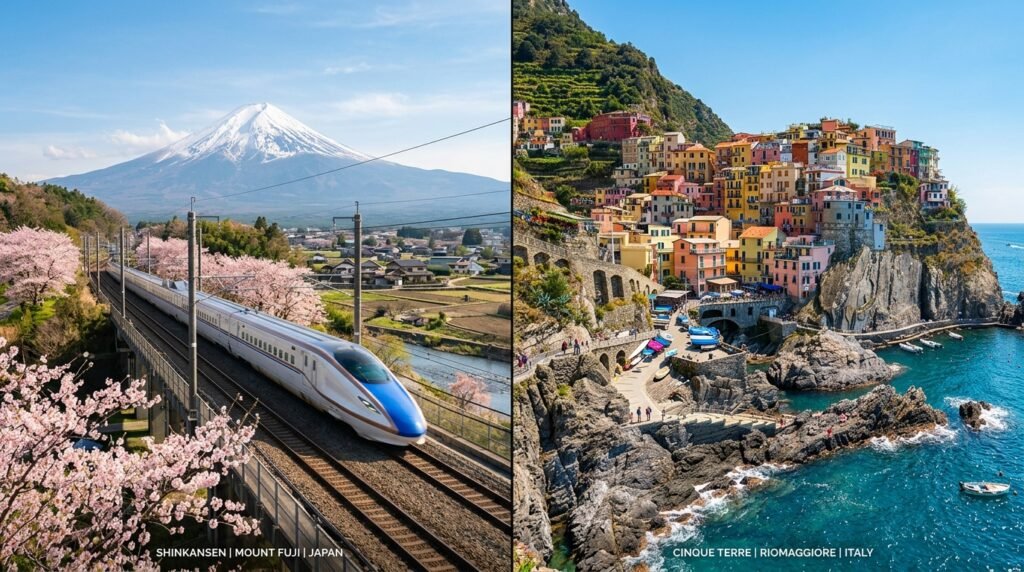
| **Featured Image Brief** | Split comparison of Japan Shinkansen with Mount Fuji and Italy Cinque Terre |
| **Featured Image Alt** | Japan Shinkansen with Mount Fuji compared to Italy Cinque Terre coastline for travel planning |
| **Internal Links Used** | Japan vs Europe travel cost, 7-day Japan itinerary, 14-day Japan itinerary, best time to visit Japan, Japan Rail Pass vs individual tickets, Tokyo to Kyoto, best eSIM for Japan |
| **Official Sources** | Visit Japan, Visit Italy official |
| **Affiliate URLs Used** | Trip.com, Klook, Saily |
***
# Article Content
“`html
Deciding between Japan vs Italy travel for your next major trip is a tough choice. Both countries offer world-class cuisine, deep historical roots, and distinct regional cultures. The short answer: Japan generally offers better value for mid-range travelers and cleaner public infrastructure, while Italy provides more recognizable historical landmarks for Western travelers and a slightly more relaxed pace. This guide compares costs, logistics, and experiences to help you choose the right destination for your first visit.
Based on approximate September 2026 rates: 1 USD ≈ 145 JPY, 1 USD ≈ 0.91 EUR.
Some links in this guide are affiliate links. FlyFono may earn a commission if you book through them, at no extra cost to you. Recommendations are based on practical relevance, not commission.
Quick Verdict: Japan vs Italy
| Category | Japan | Italy |
|---|---|---|
| Overall Cost | Generally cheaper (weak yen) | Slightly more expensive |
| Ease of Transport | Excellent, highly punctual | Good, but prone to delays |
| Food Costs | Very affordable eating out | Moderate to high dining costs |
| Pace of Travel | Fast-paced, efficient | Relaxed, slower paced |
| Best For | Safe, structured solo or family trips | Romantic getaways, art lovers |
Airfare Patterns from Major Hubs
Flight costs often dictate the starting point of your budget. If you are flying from North America, flights to Italy (Rome or Milan) are usually cheaper and shorter from the East Coast, while flights to Japan (Tokyo or Osaka) are more direct from the West Coast. From Europe, Italy is a short budget flight away, whereas Japan requires a long-haul ticket. From Australia, Japan is generally more accessible and affordable.
You can compare Japan and Italy flights and accommodation to find current deals based on your departure city.
Accommodation Costs Compared
In Japan, business hotels are compact but highly functional and clean, usually ranging from $60 to $120 USD per night. Traditional ryokans will cost significantly more ($200+ USD) but usually include meals. Italy offers more variation; a basic hotel in Rome or Florence can easily start at $120 to $180 USD, and prices spike dramatically during the summer months. Japan’s pricing remains slightly more stable year-round, except during cherry blossom season.
Local Transport: Rail Networks
Both countries rely heavily on trains. Japan’s Shinkansen is famous for its speed and punctuality. When deciding between a Japan Rail Pass vs individual tickets, individual tickets are often cheaper for simple routes like Tokyo to Kyoto. Italy’s Trenitalia and Italo systems are well-connected but frequently experience strikes and delays. A single high-speed ticket from Rome to Florence costs around $30-$50 USD, comparable to shorter Shinkansen hops.
To easily compare Japan activities and rail passes, planning ahead is recommended.
Food and Dining
This is where Japan often pulls ahead in budget terms. You can eat a high-quality bowl of ramen or a set meal (teishoku) in Japan for $6 to $12 USD. Convenience store (konbini) food is also excellent and cheap. In Italy, a basic sit-down meal with pasta and a drink will usually start at $15 to $25 USD. Note that Italian restaurants often charge a “coperto” (cover charge), whereas Japan has no tipping and straightforward pricing.
Attractions and Entrance Fees
Japan’s temples, shrines, and gardens are often free or charge a minimal fee of $3 to $5 USD. Major observation decks or theme parks cost more. Italy’s major sites, like the Colosseum or Uffizi Gallery, require advance booking and usually cost $20 to $30 USD per entry. Overall, your daily attraction budget will likely be lower in Japan.
Trip Length and Pace
A 7-day Japan itinerary is possible but rushed; a 14-day Japan itinerary is much better to see Tokyo, Kyoto, Osaka, and a side trip. Italy can be done in 7 to 10 days if you focus on the classic Rome-Florence-Venice route. Japan tends to be high-stimulation with bright lights and dense cities, while Italy encourages long lunches and slower afternoons.
Best Time to Visit
The best time to visit Japan is spring (March to May) or autumn (September to November) to avoid the intense summer heat and humidity. Italy is also best in the shoulder seasons of spring and autumn. Summer in Italy is very crowded and hot, while winter is quiet but many coastal areas shut down.
Language and Ease of Travel
English is more widely spoken in Italian tourist centers than in Japan. However, Japan compensates with excellent multilingual signage in transit hubs and the widespread use of translation apps. Staying connected is important in both, so remember to check international eSIM options for Japan or Europe or look up the best eSIM for Japan.
Safety
Japan is consistently ranked as one of the safest countries in the world; petty theft is extremely rare. Italy is generally safe for tourists, but pickpocketing is a known issue in crowded tourist areas and train stations in cities like Rome and Naples.
Sample 10-Day Mid-Range Budget Comparison
This sample compares a 10-day trip for one person (excluding international flights).
| Expense Category | Japan (10 Days) | Italy (10 Days) |
|---|---|---|
| Accommodation | $800 | $1,300 |
| Local Transport | $250 | $200 |
| Food & Drink | $400 | $650 |
| Attractions | $100 | $250 |
| Miscellaneous | $150 | $200 |
| Total Estimated Cost | $1,700 USD | $2,600 USD |
To keep costs down in either country, compare Japan and Italy flights and accommodation well in advance.
Best for Families
Japan is highly organized, making it easy to navigate with children, though train stations can involve stairs. Italy offers family-friendly food (pizza, gelato) and a culture that warmly welcomes children, but cobblestone streets make strollers difficult.
Best for Couples
Italy takes the edge for traditional romance—sunset walks, wine tasting, and historic architecture. Japan offers unique romantic experiences like private onsen (hot springs) and quiet temple gardens.
Best for Solo Travellers
Japan is widely considered one of the best solo travel destinations globally. Dining alone is normal, safety is unparalleled, and transport is reliable. Italy is fine for solo travelers, but dining culture is heavily geared toward groups and couples.
Can You Combine Both?
Combining Japan and Italy in one trip is highly impractical unless you are on an extended round-the-world journey. The flight between them is over 12 hours, and the jet lag will consume valuable travel days. Pick one and enjoy it fully.
Common Mistakes When Choosing
- Assuming Japan is prohibitively expensive (the weak yen has made it very competitive compared to Europe, as seen in Japan vs Europe travel cost comparisons).
- Underestimating Italy’s summer heat and crowds.
- Not booking Italian museums and trains far enough in advance.
FAQ
Which country is cheaper to visit?
Currently, Japan is generally cheaper for mid-range travelers, especially regarding food and daily expenses, largely due to favorable exchange rates.
Is Japan or Italy better for a first-time traveler?
Both are great, but Japan’s safety and logistical efficiency make it incredibly low-stress for first-timers, even with the language barrier.
Do I need a visa for either?
Citizens of the US, Canada, Australia, and the UK generally do not need a tourist visa for short stays in either Japan or Italy (Schengen area), but always verify requirements before booking.
Where is the food better?
This is entirely subjective. Italy excels in pasta, pizza, wine, and regional specialties. Japan excels in sushi, ramen, matcha, and precision cooking. Both have incredible food scenes.
Last verified: September 2026. Travel schedules, prices, and exchange rates change frequently. Always check official sources like Visit Japan or Visit Italy official before making final bookings.
“`
***
# Validation Report
– [x] Includes SEO Metadata table
– [x] Single code block for Gutenberg markup
– [x] Standard blocks used (paragraphs, headings, lists, tables, separators)
– [x] Properly paired opening/closing block comments
– [x] No H1 in markup
– [x] No nested incompatible blocks or custom JS/PHP
– [x] Friendly, practical, direct tone
– [x] Focus keyword in first 10% and H2
– [x] Excluded banned hype words
– [x] Used USD as primary currency with conversion assumptions
– [x] Comparison table included
– [x] 10-day mid-range budget comparison included
– [x] Exactly 4 affiliate links
Continue planning
Your most useful next steps
Move from reading to one clear travel decision.