
The practical takeaway
Compare 5 ways from Kansai Airport (KIX) to Osaka and Kyoto: JR Haruka Express, Nankai Rapi:t, limousine bus, private transfer, and taxi. Covers fares, times, and IC card discounts.
Figuring out the best way from Kansai Airport to Osaka or Kyoto can seem daunting after a long flight, but the reality is that the transport network connecting KIX to the Kansai region is world-class. The fastest and most convenient options are the JR Haruka Express for direct access to Tennoji, Shin-Osaka, and Kyoto Station, or the Nankai Rapi:t for the quickest route to the Namba area. For door-to-door convenience, especially with heavy luggage, airport limousine buses, pre-booked private transfers, and taxis offer reliable alternatives to navigating the train stations. Depending on where your hotel is located, your budget, and how much luggage you have, one of these five options will be the perfect fit.
Quick Answer: The Best Way from Kansai Airport to Osaka and Kyoto
Some links in this guide are affiliate links. FlyFono may earn a commission if you book through them, at no extra cost to you. Recommendations are based on practical relevance, not commission.
- Going to Namba or Shinsaibashi? Take the Nankai Rapi:t. It takes just 34-39 minutes directly to Namba Station.
- Going to Tennoji, Shin-Osaka, or Kyoto? The JR Haruka Express is your best bet, especially if you have a JR Pass or purchase the ICOCA & Haruka discount ticket. Book Haruka tickets online for the best rates.
- Staying at a major hotel or have lots of luggage? The Airport Limousine Bus offers direct routes to major hubs like Umeda and Kyoto Station without the hassle of carrying bags through crowded train stations.
- Traveling with a group or arriving late? A pre-booked private transfer is the most stress-free door-to-door option.
Kansai International Airport (KIX) is located on an artificial island in Osaka Bay, approximately 40 kilometers south of central Osaka and 80 kilometers southwest of Kyoto. Because of this distance, you cannot simply walk out of the terminal and be in the city center. You must choose a reliable mode of transport to cross the bridge and navigate into the urban sprawl of the Kansai region. Before you even leave the airport, it is highly recommended to set up your mobile data so you can navigate the train systems. Consider purchasing a Saily eSIM before you land so you are connected the moment you step off the plane. Taking time to properly plan your arrival will make the first leg of your Japanese adventure much smoother.
1. JR Haruka Express: Best for Kyoto, Shin-Osaka, and Tennoji
The JR Haruka Limited Express, instantly recognizable by its sleek white exterior and often adorned with Hello Kitty livery, is the premier rail service connecting Kansai Airport directly to the major JR hubs of Tennoji, Shin-Osaka, and Kyoto Station. If your final destination is one of these stations, or if you are planning to transfer to the Shinkansen (bullet train) at Shin-Osaka, the Haruka is undeniably the most efficient and comfortable choice. The train bypasses many smaller local stations, offering an incredibly smooth and direct ride straight into the heart of the region’s major transit centers.
Travel Times and Fares:
- To Tennoji: Approximately 35 minutes. (Regular unreserved fare: ~1,740 JPY)
- To Shin-Osaka: Approximately 50 minutes. (Regular unreserved fare: ~2,380 JPY)
- To Kyoto Station: Approximately 80 minutes. (Regular unreserved fare: ~2,900 JPY)
The ICOCA & Haruka Discount Ticket: One of the most important things to know about the Haruka is that you should almost never pay the regular fare. West Japan Railway Company (JR West) offers a special discount package called the “ICOCA & Haruka” ticket for foreign tourists. This package combines a discounted Haruka ticket with an ICOCA card (a rechargeable IC smart card loaded with 1,500 JPY of e-money and a 500 JPY refundable deposit). With this discount, the train fare drops significantly, making it incredibly cost-effective. The ICOCA card can then be used on almost all trains, subways, and buses across Japan, as well as in convenience stores and vending machines. It is highly recommended that you purchase this pass upon arrival or reserve it online beforehand to save money and hassle at the ticket gates.
JR Pass Coverage: The JR Haruka Express is fully covered by the nationwide Japan Rail Pass, as well as various regional JR West passes (like the Kansai Area Pass). If you are activating a JR Pass upon arrival, you can simply reserve a seat on the Haruka for free. However, if you are debating whether a nationwide pass is worth it for your trip, read our detailed breakdown on the Japan Rail Pass vs Individual Tickets. Many travelers falsely assume a JR Pass is required for the Haruka, but the ICOCA discount makes it accessible to anyone without a nationwide pass.
Luggage Handling: The Haruka trains are designed for airport travelers. Each car features dedicated luggage racks near the doors, capable of holding large suitcases. The seating is spacious, and the ride is remarkably smooth, providing a perfect opportunity to relax and enjoy the scenery as you leave the airport island. There are no limits on luggage weight as long as it fits in the designated areas, making the Haruka far superior to standard commuter trains for travelers carrying large bags.
2. Nankai Rapi:t: Best and Cheapest for Namba
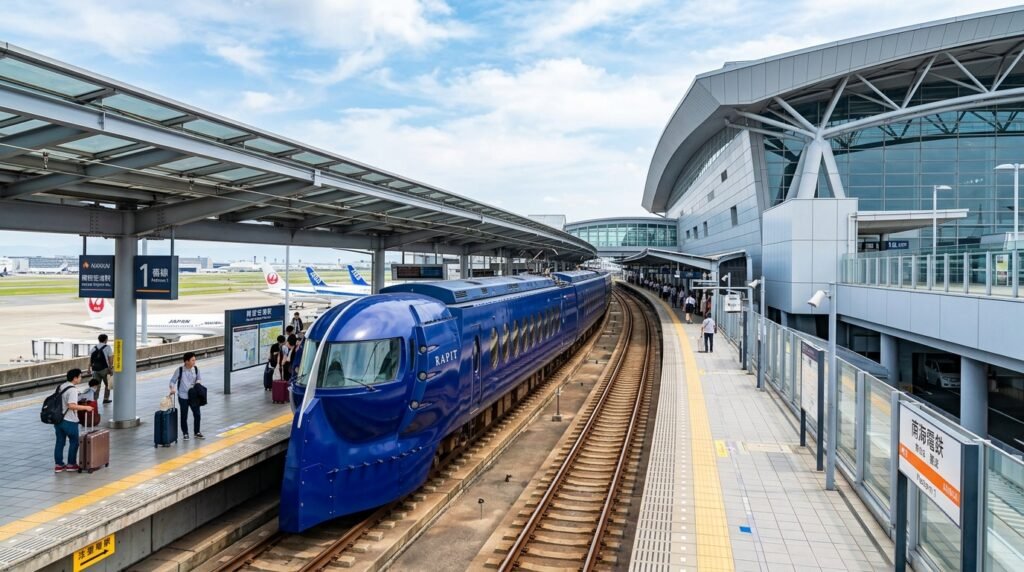
If you are trying to get from Kansai Airport to Osaka’s vibrant southern entertainment and shopping district, Namba, the Nankai Rapi:t (pronounced “rapid”) is the undisputed champion. Operated by the private Nankai Electric Railway, the Rapi:t is famous for its retro-futuristic, deep blue design that looks like a high-speed train out of a sci-fi movie. It has become an iconic part of traveling to Osaka, providing an exciting introduction to the city’s unique charm.
Travel Times and Fares:
- To Nankai Namba Station: 34 minutes (Rapi:t Alpha) to 39 minutes (Rapi:t Beta).
- Regular Fare: 1,490 JPY (includes the base fare and the mandatory limited express surcharge).
Why the Rapi:t is Ideal for Namba: Namba is the heart of Osaka’s Minami district, home to Dotonbori, Shinsaibashi, and Nipponbashi (Den Den Town). If your accommodation is in this area, taking the JR Haruka would force you to transfer at Tennoji, which is cumbersome with luggage. The Nankai Rapi:t takes you straight into the massive Nankai Namba terminal, avoiding stressful subway transfers entirely. When considering where to stay in Osaka, proximity to Namba makes the Rapi:t an incredibly appealing and time-saving airport transfer.
Discounted Online Tickets: You can often find Nankai discounted online tickets through third-party platforms. Buying your ticket in advance not only saves you a few hundred yen but also allows you to skip the sometimes lengthy ticket counter queues at the airport. You simply scan a QR code at the dedicated machines to issue your reserved seat ticket, making the whole process much faster.
Comfort and Amenities: Like the Haruka, the Rapi:t offers guaranteed seating and dedicated luggage storage areas. The seats are plush and recline deeply, ensuring a very comfortable albeit short ride into the city. Note that because the Nankai line is a private railway, the Japan Rail Pass is NOT valid on the Rapi:t. If you want to ride the Rapi:t, you must purchase a separate ticket regardless of what rail passes you hold.
3. Airport Limousine Bus: Best for Door-to-Door Convenience
While trains are fast and punctual, they have one major drawback: you still have to navigate the massive, labyrinthine stations (like Umeda or Namba) once you arrive, often dragging heavy suitcases up and down stairs or searching for elevators. This is where the Airport Limousine Bus shines, offering an unparalleled level of convenience for travelers seeking a more relaxed arrival experience.
Destinations and Fares:
- To Osaka Station (Umeda): Approx. 60-75 minutes (~1,600 JPY)
- To Namba (OCAT): Approx. 50 minutes (~1,100 JPY)
- To Universal Studios Japan (USJ): Approx. 70 minutes (~1,600 JPY)
- To Kyoto Station (Hachijo Exit): Approx. 85-100 minutes (~2,600 JPY)
The Benefits of the Bus: The Limousine Bus network at KIX is extensive. The buses depart directly from the curb outside the arrivals hall on the 1st floor of Terminal 1 (and also serve Terminal 2, which is highly convenient if you fly in on a low-cost carrier like Peach). The absolute biggest advantage of the bus is luggage handling. The staff will tag your bags, load them into the undercarriage of the bus, and hand you a claim ticket. You then board the bus, sit back, and relax until you reach your destination. You don’t have to lift a finger or worry about your suitcase rolling away on a train. For travelers exhausted after an intercontinental flight, this full-service luggage handling is a true lifesaver.
Furthermore, the buses drop you off either right in front of major hubs (like the Herbis Osaka building in Umeda) or directly at the doorsteps of major international hotels. If you are staying at a large hotel in Umeda or Kyoto, check if the Limousine Bus stops there—it can save you a tremendous amount of stress. This convenience is a key reason why many travelers building their 7-day Japan itinerary opt for the bus on arrival to minimize travel fatigue.
Important Considerations: Buses are subject to highway traffic. While traffic jams are not constantly severe, an accident or rush hour congestion on the Hanshin Expressway can delay your arrival. If you have a tight schedule (e.g., catching a specific bullet train to Tokyo or Hiroshima), a train is slightly more reliable. However, the buses run very frequently, so you rarely have to wait long for the next departure.
4. Private Transfer: Best for Groups and Absolute Peace of Mind
If budget is less of a concern and comfort is paramount, a pre-booked private transfer is the ultimate way to travel from Kansai Airport to Osaka or Kyoto. When you book a private transfer, a professional driver will be waiting for you in the arrivals hall holding a sign with your name. They will assist you with your luggage and escort you directly to a waiting vehicle, which will then drive you straight to your hotel’s front door.
Cost and Viability: Private transfers are generally the most expensive option for a solo traveler or a couple. A standard sedan transfer to central Osaka might cost anywhere from 12,000 to 18,000 JPY, and significantly more for Kyoto. However, if you are traveling with a group of 4-6 people, you can book an Alphard or a HiAce van. When you divide the cost among the group, the price per person becomes very competitive with train or bus tickets, with infinitely more convenience.
When to Book a Private Transfer:
- Late Arrivals: If your flight lands past 10:30 PM, you risk missing the last express trains and buses. A private transfer ensures you aren’t stranded in the airport terminal overnight.
- Families with Small Children: Navigating trains with strollers, luggage, and exhausted children is a nightmare. A private car removes all that stress and keeps your family together in a quiet environment.
- Heavy Luggage: If you are traveling with multiple large suitcases, skis, snowboards, or golf clubs, trains and buses will be very difficult to manage. The spacious trunks of transfer vans solve this problem easily.
You can easily book a pre-booked private transfer in advance through trusted platforms. Drivers monitor your flight status in real-time, so even if you are delayed on the tarmac or stuck in a long customs queue, they will be there waiting when you finally emerge.
5. Taxi: Best for Spontaneous Late-Night Arrivals
Taking a standard taxi from Kansai Airport is the most expensive and least recommended option for regular daytime travel, but it serves a vital purpose for late-night or emergency situations. Unlike pre-booked private transfers, you can simply walk out to the taxi rank at any hour and get in a car. This spontaneity is the main reason taxis remain an option.
Fares and Surcharges: Japanese taxis are famously clean, safe, and reliable. Drivers wear white gloves and the doors open automatically. But they are also incredibly expensive. A metered fare to central Osaka (Namba/Umeda) will easily exceed 15,000 to 20,000 JPY, and a trip to Kyoto can run upwards of 35,000 JPY or more. Furthermore, there is a late-night surcharge of 20% applied between 10:00 PM and 5:00 AM, which is precisely when most people resort to using a taxi because the trains and buses have stopped operating.
Fixed-Fare Taxis: Some taxi companies offer fixed-fare (flat rate) services to specific zones in Osaka and Kyoto. These can be slightly cheaper than a strictly metered ride, but you usually need to arrange this at the taxi counter or know which specific taxi queue to use. Even with a flat rate, expect to pay a premium. The only time a taxi is genuinely recommended is if you arrive after midnight, did not book a private transfer in advance, and desperately need to get to your hotel to sleep.
Summary Comparison Table
| Mode of Transport | Best For | Est. Time to Osaka Center | Est. Cost (JPY) | Luggage Handling |
|---|---|---|---|---|
| JR Haruka | Tennoji, Shin-Osaka, Kyoto, JR Pass holders | 50 mins (Shin-Osaka) | ~1,800 (with ICOCA discount) | Dedicated racks inside cars |
| Nankai Rapi:t | Namba area, budget express travelers | 35 mins (Namba) | 1,490 | Dedicated racks inside cars |
| Limousine Bus | Umeda area, USJ, traveling heavy | 60-75 mins (Umeda) | ~1,600 | Stowed underneath by staff |
| Private Transfer | Groups, families, late arrivals, door-to-door | 50-60 mins | 12,000+ (per vehicle) | Driver assists, private trunk |
| Taxi | Emergencies, no advance booking after midnight | 50-60 mins | 18,000+ (metered) | Driver assists, standard trunk |
Best Option by Traveller Type
Choosing the right transport from Kansai Airport to Osaka requires balancing time, budget, and convenience. Here is our breakdown of the best choices based on different types of travelers, ensuring you start your Japanese adventure on the right foot.
For the Budget Traveler
If you are trying to save every yen, the standard commuter trains are the cheapest option available. The Nankai Airport Express (the regular commuter version, not the Rapi:t) costs only 930 JPY to Namba and takes about 45 minutes. Similarly, the JR Kansai Airport Rapid Service goes to Tennoji and Osaka Station for around 1,210 JPY. However, keep in mind that these are regular commuter trains designed for locals going to work or school. You are not guaranteed a seat, and there are no dedicated luggage racks. If you board during the morning or evening rush hour with large suitcases, it will be an incredibly uncomfortable experience. We highly recommend spending the extra few hundred yen for the Rapi:t or the Haruka discount ticket for a vastly superior, stress-free experience.
For the First-Time Visitor
First-time visitors often find the massive Japanese train stations completely overwhelming. Navigating Umeda station with jet lag and heavy bags can quickly lead to frustration. If your hotel is located in Umeda or directly in Kyoto, the Airport Limousine Bus is undeniably the best choice. You simply hand over your luggage to the attendants at the airport and get dropped off directly in the city center or at a major hotel, skipping the complex transfers at Namba or Tennoji entirely. The cultural differences and bustling energy of Osaka can be a lot to take in immediately upon arrival; reading about why Americans are choosing Osaka over Tokyo can help set your expectations for this vibrant, food-obsessed city.
For Kyoto-Bound Travelers
If your ultimate destination is Kyoto, do not bother taking the Nankai line or messing with local trains that require transfers in Osaka. The JR Haruka Express is the absolute best way to get to Kyoto directly from Kansai Airport. With the ICOCA & Haruka discount, you get an incredibly fast, direct, and comfortable 80-minute ride straight to Kyoto Station without ever needing to change trains. It is smooth, efficient, and lets you immediately start enjoying the scenic transition from modern Osaka to historic Kyoto.
5 Common Mistakes at Kansai Airport
Navigating an unfamiliar international airport after a 12-hour flight is tough. Fatigue clouds your judgment. Avoid these five common pitfalls when traveling from Kansai Airport to Osaka to ensure a smooth start to your vacation.
- Assuming the JR Pass is always the best deal: Many travelers immediately activate their nationwide JR Pass at KIX just to ride the Haruka. If you are staying in Osaka for a few days before taking long-distance Shinkansen trains, activating your pass early just for an 1,800 JPY airport train is a huge waste of its validity period. Buy the ICOCA & Haruka discount ticket instead, and save your expensive JR Pass for the big bullet train journeys later in your itinerary.
- Taking the JR Haruka to Namba: The Haruka does not stop at Namba. It goes to Tennoji, where you have to switch to a crowded local subway line to get to Namba. If your hotel is in Namba or Shinsaibashi, take the Nankai Rapi:t instead. It is faster, cheaper, direct, and specifically serves that neighborhood.
- Bringing oversized luggage on commuter trains: Trying to save 500 yen by taking the local Nankai Airport Express instead of the Rapi:t during the evening rush hour with two giant suitcases is a terrible idea. You will likely stand the entire way, block the aisles, and frustrate local commuters. Pay for the reserved express train where your seat and luggage space are guaranteed.
- Not booking private transfers in advance for late flights: If you are arriving at 10:30 PM or later, immigration and customs can sometimes take over an hour. By the time you exit into the arrivals hall, the last trains and buses have often ceased operations for the night. Do not rely on walking out and finding a cheap ride. Book a private transfer ahead of time if you land late, or you’ll be at the mercy of expensive taxi meters.
- Forgetting to buy an IC Card (ICOCA) immediately: Japan runs on IC smart cards. You use them for subways, buses, vending machines, and convenience stores nationwide. Do not waste precious vacation time figuring out fare charts and buying individual paper tickets for every single subway ride in Osaka. Get an ICOCA card at the Kansai Airport train station immediately upon arrival. Better yet, get it bundled with the Haruka discount ticket so you are ready to explore the moment you drop off your bags.
Frequently Asked Questions
Can I use a Suica or Pasmo card in Osaka?
Yes, absolutely. Japan’s major IC cards are fully interoperable nationwide. If you still have a Suica or Pasmo card from a previous trip to Tokyo, you can use it on the trains, subways, and buses in Osaka and Kyoto exactly like an ICOCA card. You can even use it to pay the base fare for the Nankai Rapi:t (though you still need to buy the separate limited express reserved seat ticket before boarding). There is no need to purchase a new ICOCA card if you already have an active IC card from another region.
Is Kansai Airport open 24 hours?
Yes, the airport terminal itself remains open 24 hours a day. However, public transport options connecting the airport to the city (trains and buses) generally stop running between midnight and 5:30 AM. If you arrive in the middle of the night, you will either need to take an expensive taxi, wait in the terminal lounges until morning, or book a room at the Hotel Nikko Kansai Airport or the First Cabin capsule hotel, both of which are located directly on the airport island.
How do I buy the ICOCA & Haruka discount ticket?
You can purchase the ICOCA & Haruka ticket at the JR Ticket Office located at the Kansai Airport train station, just opposite the terminal building. You must present your physical foreign passport (with a tourist visa or temporary visitor landing permission stamp) at the counter. You cannot buy this specific discount ticket if you are a resident of Japan or traveling on a non-tourist visa. Expect a small queue during peak arrival times, but the savings make the wait worthwhile.
Which transport option is best for Universal Studios Japan (USJ)?
The absolute easiest way to get directly from Kansai Airport to Universal Studios Japan (USJ) is the Airport Limousine Bus. It drops you off right near the park entrance and the surrounding Universal CityWalk hotels, eliminating any need to navigate train transfers. Taking the train requires multiple transfers (e.g., Haruka to Tennoji, local Osaka Loop Line to Nishikujo, and then the Sakurajima line to Universal City), which is exhausting to manage with luggage and excited children in tow.
Do children ride for free?
Generally, on most Japanese trains and buses, infants and toddlers under 6 years old travel for free (assuming they do not occupy their own reserved seat and sit on a parent’s lap). Children aged 6 to 11 pay half the standard adult fare. Anyone 12 years old and above pays the full adult fare. This rule applies to both the JR Haruka and the Nankai Rapi:t services.
Final Recommendation
Your choice of transport from Kansai Airport to Osaka should be dictated primarily by where your accommodation is located and how much convenience you are willing to pay for. If your hotel is in the Minami (Namba/Shinsaibashi) area, the Nankai Rapi:t is mathematically and practically unbeatable for speed and price. If you are staying in the Kita (Umeda/Osaka Station) area, Tennoji, or heading straight to Kyoto, the JR Haruka Express—specifically using the ICOCA & Haruka discount—is the premier choice. For those who want to avoid navigating massive train stations entirely, especially families or travelers with heavy luggage, the Airport Limousine Bus or a pre-booked private transfer offers unparalleled door-to-door convenience that ensures you arrive at your hotel relaxed and ready to explore.
Last checked: October 2026.
Continue planning
Your most useful next steps
Move from reading to one clear travel decision.