
The practical takeaway
Compare express minivans, VIP buses, domestic flights, and private transfers from Phnom Penh to Siem Reap with exact prices, travel times, road conditions, and arrival points.
Last checked: September 2026.
Some links in this guide are affiliate links. FlyFono may earn a commission if you book through them, at no extra cost to you. Recommendations are based on practical relevance, not commission.
Traveling from Phnom Penh to Siem Reap is arguably the most essential and popular route in all of Cambodia. Every year, countless thousands of visitors make the journey from the bustling, energetic capital city situated at the confluence of the Mekong and Tonlé Sap rivers, heading north to the cultural heartland of Siem Reap—the gateway to the magnificent, sprawling temple complexes of Angkor Wat. The distance between the two major cities is approximately 320 kilometers (roughly 200 miles) by road, stretching across the picturesque Cambodian countryside. There are four main transport options available to complete this journey: full-size VIP buses, express minivans, domestic flights, and private transfers. For the vast majority of travelers, opting for a VIP bus or an express minivan represents the absolute sweet spot between cost, comfort, and safety, typically taking about 5.5 to 6.5 hours on the newly upgraded National Road 6. Alternatively, domestic flights take just 45 to 50 minutes in the air but require additional, sometimes lengthy, transit time to and from the new Siem Reap Angkor International Airport (SAI). Finally, private transfers offer the maximum level of convenience and privacy, taking about 5 hours door-to-door, making them perfect for families and small groups.
Quick Answer: How to Get from Phnom Penh to Siem Reap
- Fastest Option: Domestic flights take roughly 45 minutes in the air, but you must factor in 2 hours for check-in and an additional 1 hour for the transfer from the new SAI airport to downtown Siem Reap.
- Best Value: VIP Buses (such as Giant Ibis and Mey Hong) cost around $16-$18, offering spacious, comfortable seating, excellent safety records, and generous luggage allowances.
- Most Convenient: Private transfers provide seamless door-to-door service on your exact schedule, costing between $90 and $130, which is very competitive for small groups.
- Most Frequent: Express minivans (like Larryta) depart almost hourly throughout the day, offering a slightly faster road trip for those who travel light.
Comparing the 4 Transport Options
When deciding how to get from the vibrant streets of Phnom Penh to the ancient wonders of Siem Reap, it is crucial to weigh the various factors that will impact your journey. Time, cost, comfort, and luggage capacity all play significant roles in determining the best fit for your specific travel style. Below is a comprehensive comparison table to help you evaluate your choices at a glance.
| Transport Mode | Estimated Time (Door-to-Door) | Approximate Cost (Per Person/Vehicle) | Comfort Level | Luggage Limits |
|---|---|---|---|---|
| VIP Bus (Giant Ibis, Mey Hong) | 6 – 6.5 Hours | $16 – $18 per ticket | High (Spacious seating, AC, onboard Wi-Fi) | 1 large checked bag + 1 carry-on |
| Express Minivan (Larryta, etc.) | 5.5 – 6 Hours | $12 – $15 per ticket | Moderate (Tighter space, fast-paced) | 1 medium bag + small personal item |
| Domestic Flight (SAI Airport) | 3.5 – 4.5 Hours total transit | $40 – $120+ flight plus $30 taxi | High in air, tedious on ground | Strict airline limits (usually 15-20kg) |
| Private Transfer (Car/SUV) | 5 – 5.5 Hours | $90 – $130 per vehicle | Very High (Private, customizable stops) | Flexible, depends on the vehicle trunk size |
1. Full-Size VIP Buses: The Best Balance of Comfort and Price
If you are traveling with standard luggage sizes and are looking for a reliable, highly comfortable journey that will not break your travel budget, a full-size VIP bus is widely considered the absolute best choice. Over the years, companies like Giant Ibis and Mey Hong have firmly established themselves as the premium, go-to operators on the Phnom Penh to Siem Reap route, elevating bus travel from a grueling chore to a surprisingly pleasant experience.
What to Expect on a Premium VIP Bus
The VIP buses deployed on this popular route are typically modern, 30 to 35-seater coaches. They are usually arranged in a 2+1 or 2+2 seating configuration, meaning that the seats are significantly wider, softer, and offer much more legroom than those found on standard, packed local coaches. The recline is often generous, allowing you to relax or sleep comfortably. You can expect strong, sometimes overly enthusiastic air conditioning—it is highly recommended that you bring a sweater, light jacket, or scarf, as it can get quite chilly during the six-hour ride. Onboard amenities generally include complimentary bottled water, refreshing cold towels, and occasionally a small snack. Power outlets or USB charging ports are usually available at every seat, ensuring your devices stay charged. Onboard Wi-Fi is standard, though it is important to temper your expectations; coverage can be spotty and slow when passing through rural, remote agricultural areas.
Safety is perhaps the most significant selling point for these top-tier bus companies. Giant Ibis, for example, is renowned for strictly enforcing speed limits and requiring all passengers to wear seatbelts. They also typically assign two drivers for longer journeys, or ensure that drivers take adequate breaks, meaning driver fatigue—a genuine concern on some local operators—is virtually never an issue.
Journey Time, Rest Stops, and Road Conditions
The journey itself takes around 6 to 6.5 hours from terminal to terminal. While the distance of 320 kilometers might seem like it should take less time, the speed limits on National Road 6 are strictly enforced, and navigating the often chaotic traffic when leaving the outskirts of Phnom Penh and entering Siem Reap can add significant chunks of time to the trip. The road itself, however, is in excellent condition following massive upgrade projects over the last decade. It is a smooth, dual-carriageway asphalt road for the vast majority of the route, meaning you won’t be subjected to the bone-rattling bumps that characterized Cambodian travel in the early 2000s.
The buses always make at least one designated 30-minute rest stop roughly halfway through the journey, usually near the provincial town of Kampong Thom. These stops are made at large, decent roadside restaurants where you can purchase hot meals, buy various local snacks (ranging from fresh fruit to more adventurous fried insects, if you are so inclined), use remarkably clean and modern restrooms, and stretch your legs before the second half of the drive.
Booking Your VIP Bus Tickets
Tickets typically cost between $16 and $18 per person, representing incredible value for the level of service provided. You can easily and securely book Klook bus & minivan tickets well in advance, which is highly recommended during the peak tourist season from November to March. Giant Ibis operates out of their own dedicated, organized terminal near the Night Market in Phnom Penh and arrives at their dedicated terminal in Siem Reap, which is centrally located and easily accessible by tuk-tuk to any hotel. Mey Hong offers similar centralized pickup and drop-off points. Both companies are incredibly accommodating with luggage, generally allowing one large suitcase (weighing up to 20kg or slightly more) which is safely stored in the compartment beneath the bus, along with one small daypack or purse that you can keep with you on board.
If you are currently comparing the vibe of Phnom Penh vs Siem Reap for your broader itinerary, taking the bus provides a fantastic, ground-level window into the lush Cambodian countryside, small villages, and daily rural life that exists between the two major urban centers.
2. Express Minivans: Faster, Frequent, but Snug and Compact
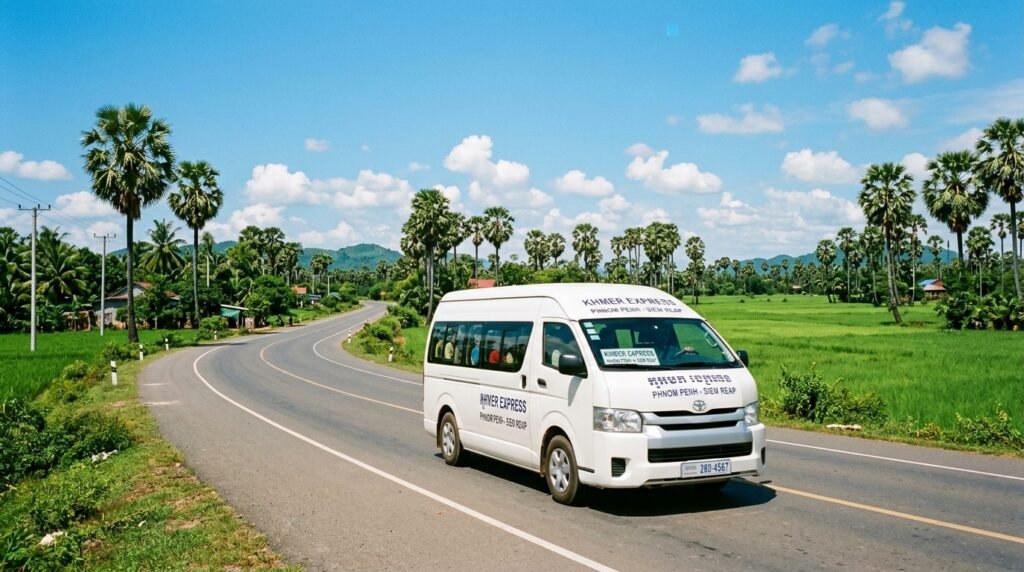
For travelers who prioritize high frequency of departures and a slightly faster overall transit time over maximum legroom and luxury, express minivans are an excellent, highly viable alternative. Operators like Larryta Express have modernized this segment of the market, running vast fleets of brand-new, 15-seat Ford Transit or Toyota HiAce vans that zip back and forth between the cities all day long.
The Minivan Riding Experience
Minivans are inherently more nimble and maneuverable than full-size coaches. This allows them to navigate heavy city traffic much more efficiently, overtake slower trucks on National Road 6 more easily, and ultimately shave about 30 to 45 minutes off the total travel time, bringing the journey down to a brisk 5.5 to 6 hours. Larryta is particularly famous for its incredibly frequent departure schedule—they sometimes have vans leaving every hour on the hour, from very early in the morning until mid-afternoon. This extreme flexibility is absolutely perfect if your travel plans are subject to sudden change, if you want to maximize a morning of sightseeing in Phnom Penh before leaving, or if you simply prefer to travel at a highly specific time of day.
However, this speed and frequency come with a very noticeable trade-off: physical space. Even in the most modern, reputable minivans, the seats are positioned much closer together than on a VIP bus. Legroom is decidedly limited, and there is absolutely no room to stand up, stretch, or walk around during the drive. If you are exceptionally tall, have long legs, or are prone to claustrophobia, the VIP bus is a much safer, more comfortable choice. Additionally, because they are lighter vehicles, minivans can feel a bit bumpier and more erratic on any uneven sections of the road compared to the smooth, heavy glide of a large coach.
Strict Luggage Limitations
The single most important factor to consider when booking a minivan is the strict luggage limitation. Luggage space in these vans is notoriously tight. There is usually only a very small, cramped compartment in the extreme rear of the van. If the van is fully booked with 15 passengers, accommodating multiple large, hard-shell suitcases becomes a massive logistical problem. As a rule, you are generally restricted to one medium-sized suitcase or backpack (weighing around 15kg max) and a small carry-on item that must fit on your lap or squeezed at your feet.
If you travel heavy with massive bags, you will likely be required to purchase a second full-price passenger seat just to hold your luggage. Minivan tickets cost around $12 to $15. As with the VIP buses, booking your seat in advance through Klook is highly recommended to secure your preferred departure time.
3. Domestic Flights: Quick in the Air, but Factor in Massive Airport Transfers
Historically, flying directly from Phnom Penh International Airport (PNH) to Siem Reap was the automatic choice for luxury travelers, business people, and anyone extremely short on time. However, the dynamics, logistics, and appeal of this option changed drastically with the opening of the brand-new Siem Reap Angkor International Airport (SAI) in late 2023, which fundamentally altered travel times.
The Flight Experience and Airlines
The domestic flight itself remains incredibly brief and efficient—often taking just 45 to 50 minutes from wheels up to touchdown. The main carriers consistently operating this route are Cambodia Angkor Air and Cambodia Airways. The aircraft utilized are typically reliable ATR 72 turboprops or small Airbus A320 jets. The inflight service is minimal but perfectly adequate for such a short hop, but you are absolutely subject to standard, often strict airline luggage restrictions (usually 15-20kg for checked baggage, depending heavily on the specific fare class you book, with hefty fees for excess weight). For checking current flight availability, comparing schedules, and securing the best fares, you can rely on Trip.com flights & hotel booking.
The “New SAI Airport” Factor
The single most critical factor to evaluate when considering a flight is the location of the new Siem Reap airport. The old airport was famously located just a convenient 15-minute tuk-tuk ride from the city center and the temples. In stark contrast, the newly constructed, massive Siem Reap Angkor International Airport (SAI) is located roughly 45 to 50 kilometers away from downtown Siem Reap. This journey takes a minimum of 1 hour by private taxi or airport shuttle bus.
When you start to add up the logistical time: 45 minutes to get to PNH airport in Phnom Penh, arriving 1.5 to 2 hours early for check-in and security, taking the 45-minute flight, waiting 30 minutes for luggage at SAI, and finally taking the 1-hour taxi transfer into downtown Siem Reap, the total door-to-door travel time easily swells to 4 or 5 hours. (You can read more about navigating this complex arrival process in our dedicated Siem Reap Airport to City guide).
Because the total, realistic travel time for flying is now only 1 to 2 hours faster than taking a comfortable VIP bus, while costing significantly more money ($40-$120 for the flight itself, plus an unavoidable $25-$35 for the SAI airport taxi), flying is no longer the obvious, undisputed luxury choice it once was. The major exception is if you are arriving in Phnom Penh on an international flight and can seamlessly transit and connect directly to Siem Reap without leaving the PNH airport.
4. Private Transfers: The Ultimate Door-to-Door Convenience
If you highly value your privacy, demand maximum comfort, and desire the absolute ability to control your own schedule down to the minute, a private taxi or dedicated transfer is the ultimate way to travel between Phnom Penh and Siem Reap. This option is particularly appealing and highly recommended for families traveling with young children, small groups of friends splitting the cost, or older travelers who want to avoid the minor chaos of bus terminals.
The Unmatched Convenience of Private Cars
The core appeal of a private transfer is its seamless nature. A professional driver will pick you up directly from the lobby of your hotel in Phnom Penh, handle all your luggage, and drop you directly at the doorstep of your chosen accommodation in Siem Reap. The drive via National Road 6 still takes about 5 to 5.5 hours, but the major advantage is that you dictate the departure time. You can leave at dawn to beat the traffic, or after a leisurely late breakfast. Furthermore, you can ask the driver to stop whenever you wish for bathroom breaks, meals at specific restaurants, or even quick photo opportunities of the beautiful rural landscape along the way.
The vehicles used for these long-distance transfers are typically modern, meticulously clean, heavily air-conditioned sedans (such as the ubiquitous Toyota Camry) or spacious SUVs (like a Lexus RX or Toyota Highlander), offering plenty of space to stretch out in total comfort. Luggage capacity is only limited by the physical trunk size of the specific vehicle you book, meaning you rarely have to worry about the strict limits imposed by minivans or airlines.
Costs and Secure Booking
Prices for a standard, comfortable sedan start around $90 to $100 for the entire vehicle, while larger SUVs or private minivans (ideal for larger groups or massive amounts of luggage) range from $120 to $150. When this cost is split among two, three, or four passengers, the price per person becomes incredibly competitive with flying, while offering a vastly superior, stress-free level of convenience. You can easily arrange secure, pre-priced, guaranteed rides through GetTransfer private transfers. Using a reputable platform ensures you get a vetted, professional driver and completely eliminates the stressful need to haggle over prices with local taxi drivers on the street.
Best Option by Traveller Type
Ultimately, choosing the correct mode of transport depends heavily on your specific budget, your personal travel style, and your overarching time constraints. Here is a definitive breakdown of the best choices based on different profiles of travelers navigating Cambodia:
- Budget Backpackers and Solo Travelers: The full-size VIP Bus (specifically Giant Ibis) is the undisputed, hands-down winner. It is highly inexpensive, remarkably safe, exceptionally comfortable, provides a chance to meet other travelers, and ensures you won’t have to stress about strict luggage limits or exorbitant excess baggage fees.
- Families with Children: A Private Transfer is highly, emphatically recommended. The ability to stop whenever a bathroom break is urgently needed, to control the temperature of the air conditioning, and to entirely avoid the logistical hassle of crowded bus terminals or massive airports makes the 5-hour journey exponentially smoother and more pleasant for both parents and kids.
- Luxury Travelers and Short Itineraries: If you are on an incredibly tight schedule, perhaps meticulously following a strict Cambodia 7-day itinerary, a Domestic Flight or a high-end Private Transfer SUV will save you the most time and hassle. If your luxury hotel in Siem Reap offers a complimentary VIP airport pickup from the new SAI airport, flying can still be a very smooth, efficient, and glamorous experience.
- Digital Nomads and Frequent, Agile Travelers: The Express Minivan offers the unmatched flexibility of near-hourly departures. This allows you to wrap up a morning of remote work in a Phnom Penh cafe, grab a quick lunch, and still arrive in Siem Reap in time for dinner and a walk down Pub Street. (Just remember to stay connected throughout the rural journey with a reliable, high-speed Saily eSIM).
Common Mistakes When Traveling Between Phnom Penh and Siem Reap
While the journey north to Siem Reap is straightforward and heavily traveled, many first-time visitors fall into a few common, easily avoidable traps. Dodging these mistakes will make your trip significantly more enjoyable and stress-free:
- Underestimating the SAI Airport Transfer Time: We cannot stress this enough. Many travelers excitedly book a cheap 45-minute flight thinking they will save half a day, only to shockingly realize upon landing that the new Siem Reap Angkor International Airport (SAI) is an hour away from the city center, costing them time and an extra $30 in taxi fare. Always factor this transfer time and hidden cost into your final decision.
- Booking Unverified, Ultra-Cheap “Local” Buses: While you can easily find local bus tickets for as low as $8 or $9 through various guest houses, these are almost always cramped, older vehicles that lack functional, reliable air conditioning. They stop constantly along the highway to pick up local cargo (ranging from rice sacks to live chickens) and random passengers, dragging a 6-hour trip into a 9-hour ordeal. They also frequently have highly questionable safety records. Stick to reputable, premium companies like Giant Ibis or Mey Hong.
- Not Booking in Advance During Major Holidays: During massive Cambodian national holidays—such as the Khmer New Year (usually in April) or the Water Festival (typically in November)—buses, minivans, and flights completely sell out weeks in advance as locals travel en masse to their home provinces. Always, always secure your tickets as early as possible during these peak periods.
- Overpacking for a Compact Minivan: If you book a minivan ticket and show up at the terminal dragging two massive 25kg hard-shell suitcases, you will likely be flatly denied boarding or forced to buy an extra passenger seat just for your luggage, if one is even available. Pack smart and light for minivans.
- Forgetting Crucial Visa Requirements: Ensure you have your visa situation completely sorted before arriving, especially if you are connecting internationally through Phnom Penh. Read our comprehensive Cambodia Visa on Arrival Guide for the absolute latest requirements and avoid getting stuck at immigration.
Frequently Asked Questions (FAQs)
How long is the bus ride from Phnom Penh to Siem Reap?
The standard VIP bus ride typically takes between 6 and 6.5 hours, heavily depending on the severity of the traffic when exiting Phnom Penh and entering the outskirts of Siem Reap. Express minivans are slightly faster, generally completing the journey in about 5.5 to 6 hours.
Is there a night train between Phnom Penh and Siem Reap?
No, there is currently no passenger train service of any kind operating directly between Phnom Penh and Siem Reap. The existing railway network in Cambodia connects Phnom Penh south to the coast (Kampot and Sihanoukville) and northwest to the Thai border at Poipet, but it entirely bypasses Siem Reap.
Are night buses safe in Cambodia?
While “hotel bus” sleeper services definitely operate on this route overnight, we generally recommend traveling during the daylight hours. Night driving in Cambodia inherently carries a higher risk profile due to poorly lit rural roads, heavy, fast-moving cargo trucks, and the increased risk of driver fatigue. If you absolutely must travel at night to save on a hotel room, exclusively use a premium, highly rated operator like Giant Ibis, which rigorously employs two drivers per trip for safety.
How much does a taxi cost from Phnom Penh to Siem Reap?
A dedicated private taxi or transfer typically costs between $90 and $130, largely depending on the exact vehicle type (a standard sedan vs. a larger SUV) and the method you use to book it. Pre-booking through reliable, verified online platforms ensures a fixed, transparent price and a vetted driver, protecting you from scams.
Can I take a boat from Phnom Penh to Siem Reap?
Technically, yes, but only during the wet season (roughly August to November) when the water levels on the massive Tonle Sap lake are high enough for passenger ferries to navigate. However, the boat journey is exceptionally long (often 6 to 8 hours), relatively expensive ($35 or more), incredibly noisy due to large engines, and often completely lacks modern safety standards or life jackets. It is largely considered a nostalgic novelty rather than a practical mode of transport, and most modern travelers find the smooth road options vastly superior and safer.
Final Recommendation
After carefully evaluating all four transportation options, for the vast majority of tourists, backpackers, and general travelers, the VIP Bus (and specifically the Giant Ibis service) stands out clearly as the absolute best overall option for traveling from Phnom Penh to Siem Reap. It offers an unbeatable, highly refined combination of road safety, onboard comfort, generous luggage capacity, and fantastic value for money. While domestic flights might initially seem much faster on paper, the remote, distant location of the new Siem Reap Angkor International Airport negates much of the supposed time savings and significantly increases both the cost and the logistical hassle of the overall journey. However, if your budget is less of a concern and you prioritize seamless convenience above all else, booking a Private Transfer is an excellent, entirely stress-free alternative that delivers you exactly door-to-door in total, climate-controlled comfort on your own schedule.
Continue planning
Your most useful next steps
Move from reading to one clear travel decision.