
The practical takeaway
Arriving in Japan and figuring out how to get from Haneda Airport to Tokyo doesn't need to be stressful. Unlike Narita, which is located much further out in Chiba Prefecture, Haneda Airport (HND) is practically in the city. Depending on your destination…
Arriving in Japan and figuring out how to get from Haneda Airport to Tokyo doesn’t need to be stressful. Unlike Narita, which is located much further out in Chiba Prefecture, Haneda Airport (HND) is practically in the city. Depending on your destination and the transport method you choose, you can be standing in central Tokyo less than 30 minutes after clearing customs and grabbing your luggage.
Because Haneda is so close to the city center, you have several excellent transit options. Whether you prioritise saving money, travelling in absolute comfort after a long flight, or simply getting to your hotel as fast as possible, there is a transport method that suits your travel style. If you are still deciding which airport to fly into, check out our Haneda vs Narita comparison.
Some links in this guide are affiliate links. FlyFono may earn a commission if you book through them, at no extra cost to you. Recommendations are based on practical relevance, not commission.
Quick Comparison: Haneda Airport to Tokyo Transport
To help you decide instantly, here is a quick overview of the 5 main transport options from Haneda Airport into central Tokyo.
| Option | Time to Center | Cost Estimate | Best For | Night Service |
|---|---|---|---|---|
| Tokyo Monorail | 13-15 mins (to Hamamatsucho) | $ (Low) | Fast access to JR Yamanote Line | Until approx. 23:30 |
| Keikyu Line Train | 11-18 mins (to Shinagawa) | $ (Low) | Direct access to Asakusa & Shinagawa | Until approx. 23:30 |
| Airport Limousine Bus | 45-60 mins | $$ (Moderate) | Direct hotel drop-offs without transfers | Limited (some early/late buses) |
| Taxi | 30-45 mins | $$$$ (High) | Convenience and door-to-door comfort | 24/7 (Late night surcharge applies) |
| Private Transfer | 30-45 mins | $$$$ (High) | Families, heavy luggage, late arrivals | 24/7 (pre-booked) |
Ready to lock in your transport or start exploring? You can Compare Haneda Airport transport and Tokyo activities to find the best deals for your travel dates.
1. Tokyo Monorail: Fast and Scenic
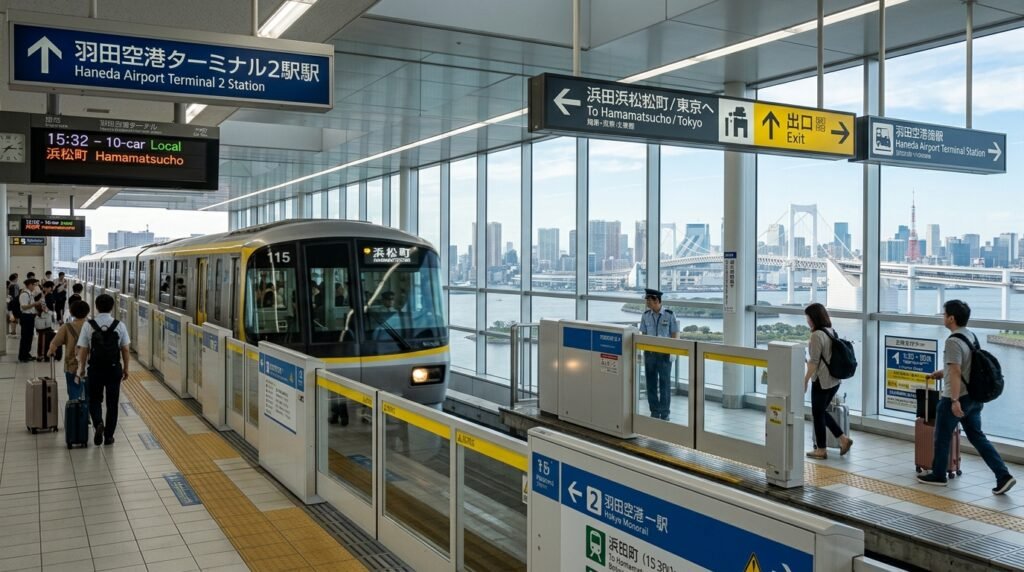
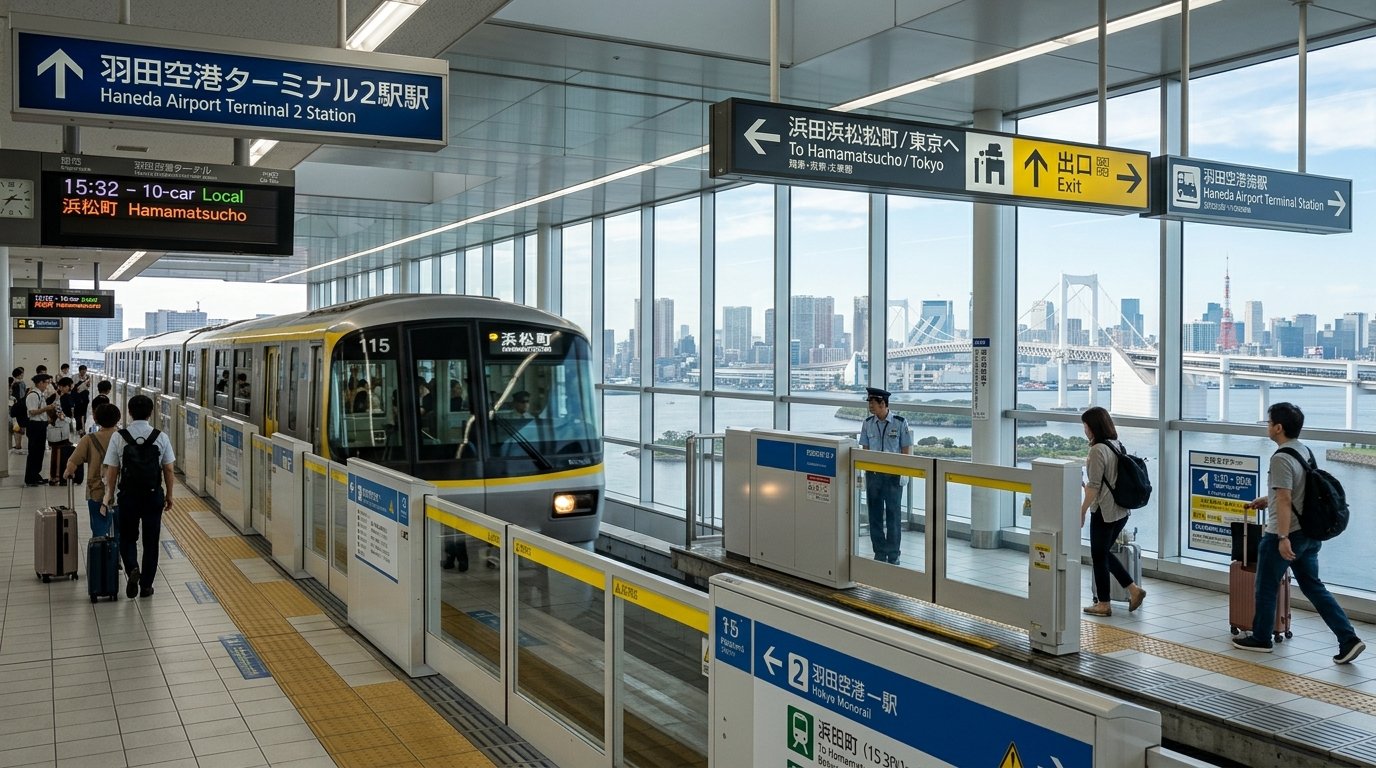
The Haneda Airport monorail is arguably the most famous way to enter the city. It’s incredibly fast, departing from all three Haneda terminals and running directly to Hamamatsucho Station in as little as 13 minutes on the Haneda Express service.
From Hamamatsucho Station, it’s very easy to transfer to the JR Yamanote Line, which runs in a loop around central Tokyo, connecting you to major hubs like Tokyo Station, Akihabara, Ueno, Shibuya, and Shinjuku. The monorail is a fantastic option if you are travelling with a Japan Rail (JR) Pass, as the monorail is fully covered by it.
- Pros: Extremely fast to Hamamatsucho, frequent departures (every 3-5 minutes), scenic views of Tokyo Bay, fully covered by JR Pass.
- Cons: Requires a transfer at Hamamatsucho if your hotel isn’t nearby. Navigating commuter crowds on the Yamanote line with heavy luggage can be challenging.
2. Keikyu Line: The Commuter Favourite
The Keikyu Line is the other major train service operating out of Haneda Airport. Rather than Hamamatsucho, the Keikyu Airport Line takes you to Shinagawa Station in as little as 11 minutes (via the Airport Express). From Shinagawa, you can also easily transfer to the JR Yamanote Line or the Tokaido Shinkansen if you’re immediately heading to Kyoto or Osaka.
One major advantage of the Keikyu line is that some trains through-operate onto the Toei Asakusa Subway Line. This means you can stay on the same train and get off directly in neighbourhoods like Ginza (via Higashi-Ginza station) or Asakusa without having to change trains.
- Pros: Very fast to Shinagawa, direct connection to the Asakusa subway line, cheap.
- Cons: It is a commuter train, so there is limited dedicated luggage space. Not covered by the JR Pass.
3. Airport Limousine Bus: Hassle-Free Drops
If the thought of dragging a 20kg suitcase through a crowded Tokyo train station fills you with dread, the Haneda Airport bus is your best friend. The Airport Limousine Bus operates routes from Haneda directly to major transport hubs and major hotels across Tokyo.
The bus staff will load your luggage underneath the bus at the airport, and you don’t have to touch it again until you arrive at your destination. It’s slightly slower than the train due to Tokyo traffic, but the convenience is unbeatable.
- Pros: Dedicated luggage storage, guaranteed seating, direct drop-offs to major hotels, free Wi-Fi on board most buses.
- Cons: Subject to traffic delays, slightly more expensive than the train, schedules are less frequent than train departures.
4. Taxi: Door-to-Door Convenience
Taking a Haneda Airport taxi is the most straightforward way to get to your accommodation, but it’s also going to cost you. Because Haneda is relatively close to the city centre, a taxi is much more viable here than it is from Narita.
Taxis operate on a fixed-fare system to certain zones in Tokyo from Haneda Airport, though you still need to pay highway tolls on top of the fixed fare. Late-night surcharges (usually 20%) apply between 22:00 and 05:00. This is a great option if you arrive very late at night when public transport has stopped.
- Pros: 24/7 availability, absolute door-to-door service, private and comfortable.
- Cons: Very expensive, standard sedans may struggle to fit a family of four with heavy luggage.
5. Private Transfer: Ultimate Peace of Mind
If you are travelling with a larger group, have a lot of luggage, or simply want someone waiting for you in the arrivals hall with a nameboard, booking a private transfer is the way to go. It removes the language barrier and the stress of explaining where your hotel is to a taxi driver.
For groups of 4-6 people, a private transfer in a minivan can sometimes work out to be a similar price per person as taking the Airport Limousine Bus, making it surprisingly economical. You can Check private Haneda Airport transfers ahead of time to lock in a fixed rate.
- Pros: Driver meets you at arrivals, fixed price with no hidden toll fees, vehicles size chosen to match your luggage needs, runs 24/7.
- Cons: Needs to be booked in advance, premium pricing for solo travellers or couples.
Haneda Airport to Shinjuku
Shinjuku is one of the most popular places to stay in Tokyo. To get from Haneda Airport to Shinjuku quickly, the best train route is taking the Keikyu Line to Shinagawa, and transferring to the JR Yamanote Line to Shinjuku Station. The total journey takes roughly 45 minutes.
If you have heavy luggage, navigating Shinjuku Station (the busiest train station in the world) can be overwhelming. In this case, taking the Airport Limousine Bus directly to Shinjuku Expressway Bus Terminal (Busta Shinjuku) or directly to your Shinjuku hotel is highly recommended.
Haneda Airport to Shibuya
For those staying near the famous scramble crossing, travelling from Haneda Airport to Shibuya is similar to reaching Shinjuku. Take the Keikyu Line to Shinagawa, and switch to the JR Yamanote Line bound for Shibuya. Expect the trip to take about 40 minutes.
Alternatively, the Limousine Bus drops off at major Shibuya hotels like the Shibuya Excel Hotel Tokyu or the Cerulean Tower Tokyu Hotel. If you are comparing neighbourhoods, read our guide on where to stay in Tokyo to see which hub fits your itinerary.
Haneda to Tokyo Station
If you are immediately catching a bullet train to another city, you’ll need to know how to get from Haneda to Tokyo Station. The Tokyo Monorail is your best bet here. Take the monorail to Hamamatsucho, then transfer to the JR Yamanote Line or JR Keihin-Tohoku Line to Tokyo Station. It’s a quick trip, usually under 35 minutes.
Haneda Airport to Asakusa
Asakusa is a fantastic, more traditional neighbourhood to stay in. The absolute best way to get there is via the Keikyu Line. Make sure you board a train bound for Inba-Nihombashi or Narita Airport, as these trains run straight through onto the Toei Asakusa subway line. This gives you a direct, one-seat ride from Haneda Airport to Asakusa station in roughly 40-45 minutes.
Late-Night Arrivals: What Actually Runs After Midnight?
If your flight lands after 22:30, your transit options begin to shrink drastically. Both the Tokyo Monorail and the Keikyu line run their last trains around 23:30 to 23:45. If you land at 23:00, by the time you clear immigration and get your bags, you will likely miss the last train.

Late-night buses run very limited services to major hubs, but they shouldn’t be entirely relied upon as they can fill up fast or have schedule changes. If you arrive past midnight, a taxi or a pre-booked private transfer are your only reliable, stress-free options.
To avoid spending the night on an airport bench, we strongly advise booking your first night’s accommodation well in advance. You can Compare Tokyo accommodation by neighbourhood to ensure you have a bed waiting for you.
Families and Heavy Luggage
Navigating Tokyo’s train stations with prams, toddlers, and multiple large suitcases during rush hour (07:30 – 09:00 and 17:00 – 19:00) is a recipe for a bad start to your holiday. The Keikyu line and the Yamanote line are commuter trains—they do not have dedicated luggage racks and get incredibly packed.
If you are travelling heavy or with young children, avoid the train during these peak hours. Opt for the Airport Limousine Bus or a private transfer. It will cost more, but the reduction in stress is entirely worth it.
IC Cards and Payment Methods
To use the Monorail or Keikyu line, you need a ticket or a transit IC card (like Suica or Pasmo). Physical Suica/Pasmo cards have been subject to shortages recently, but Haneda Airport often has “Welcome Suica” or “Pasmo Passport” cards specifically for tourists available at the station gates in Terminal 3.
If you have an iPhone, you can add a digital Suica or Pasmo directly to your Apple Wallet before you even fly to Japan. To load money onto it and to use mapping apps to find your way, you will need internet access upon landing. Make sure you Check Japan eSIM options before your trip so you connect to a local network immediately upon touchdown.
If you are exploring more of Japan, consider reading our 7-day Japan itinerary to see if purchasing a nationwide JR Pass makes financial sense for your trip.
Terminal 1 vs Terminal 2 vs Terminal 3
Haneda Airport is split into three terminals:
- Terminal 3: The main international terminal. If you are flying into Haneda from overseas, you will almost certainly land here.
- Terminal 2: Primarily ANA domestic flights, though a small number of ANA international flights operate from here.
- Terminal 1: Exclusively domestic flights (mostly JAL).
Both the Tokyo Monorail and the Keikyu Line have stations at Terminal 3, as well as separate stations serving Terminal 1 & 2. Always follow the clear English signs in the arrivals hall directing you down to the station platforms.
5 Expensive Mistakes Travellers Make at Haneda
- Assuming their JR Pass is active: While the Monorail is covered by the JR Pass, you must physically exchange your voucher for the pass at the airport office. The office closes at night, so if you arrive late, you must pay out of pocket.
- Taking a taxi to Narita by accident: Double-check your departure airport when leaving Tokyo. Taking a taxi from Haneda to Narita, or from Tokyo city to the wrong airport, is an incredibly costly error. (See our Narita Airport to Tokyo guide if you fly out from there).
- Getting on the wrong Keikyu Train: Some Keikyu trains head south towards Yokohama instead of north towards Shinagawa/Tokyo. Check the electronic boards and board the train heading to Shinagawa/Asakusa.
- Not checking late-night transport: Assuming trains run 24/7 is a common mistake. If you land at 23:30, do not rely on the train.
- Forgetting to verify fares: Transport fares fluctuate. Always check the official sites for the Tokyo Monorail or Keikyu line for the most up-to-date pricing rather than relying on outdated blog posts.
Frequently Asked Questions
Which is faster: Monorail or Keikyu Line?
The Keikyu Line is slightly faster to Shinagawa (approx. 11 mins) than the Monorail is to Hamamatsucho (approx. 13 mins). However, the “fastest” route depends entirely on your final destination in Tokyo. If you are heading to Asakusa, Keikyu is significantly faster due to the direct connection.
Can I use the Japan Rail (JR) Pass from Haneda Airport?
Yes, but only on the Tokyo Monorail. The Keikyu Line is a private railway and is not covered by the JR Pass. Note that you must exchange your pass voucher at the JR East Travel Service Center at Terminal 3 before you can use it.
Where can I buy a Suica card at Haneda Airport?
You can purchase a “Welcome Suica” (tourist version) at the JR East Travel Service Center or from specific ticket machines near the Monorail gates in Terminal 3. Alternatively, iPhone users can add a digital Suica directly to their Apple Wallet without needing a physical card.
Is Haneda Airport better than Narita?
For most travellers, yes. Haneda is located about 15km from central Tokyo, making it much faster and cheaper to reach the city compared to Narita, which is over 60km away. If you have the choice, flying into Haneda will save you time and hassle.
Conclusion
Getting from Haneda Airport to Tokyo is one of the easiest airport transit experiences in the world. For most travellers without heavy luggage, the Keikyu Line or the Tokyo Monorail will provide fast, cheap, and reliable access to the city. If you want maximum convenience or are travelling with a family, the Airport Limousine Bus or a private transfer are absolutely worth the extra cost.
Travel Disclaimer: Transport schedules, routes, and prices in Tokyo can change. We recommend checking the official Haneda Airport, Keikyu Corporation, or Tokyo Monorail websites for the latest timetables and exact current fares before your trip to ensure a smooth arrival.
Continue planning
Your most useful next steps
Move from reading to one clear travel decision.