
The practical takeaway
If you are wondering how to get from Incheon Airport to Seoul as quickly and comfortably as possible, the AREX Express Train is usually the best answer. Taking just 43 minutes to reach Seoul Station, it bypasses the city's notorious traffic, offers…
If you are wondering how to get from Incheon Airport to Seoul as quickly and comfortably as possible, the AREX Express Train is usually the best answer. Taking just 43 minutes to reach Seoul Station, it bypasses the city’s notorious traffic, offers dedicated luggage racks, and provides guaranteed reserved seating. However, depending on exactly where your accommodation is located, an airport limousine bus, a convenient taxi, or a pre-booked private transfer might actually save you time and physical exertion by avoiding complex subway transfers with heavy baggage.
Some links in this guide are affiliate links. FlyFono may earn a commission if you book through them, at no extra cost to you. Recommendations are based on practical relevance, not commission.
In this comprehensive guide updated for August 2026, we will compare every practical way to travel from the airport to the city center. Whether you are arriving during the busy morning rush, landing late at night, or traveling with a large family, you will find the exact route that suits your itinerary and budget. Navigating South Korea’s bustling capital begins the moment you step off the plane, and making the right transit choice can set a positive tone for your entire trip. For a quick overview of costs and alternative options before you read further, you can Compare Incheon Airport transport options.
Before jumping into the details, it is important to know that Incheon International Airport (ICN) is located on a reclaimed island approximately 48 kilometers (30 miles) west of Seoul. Despite the distance, the transport links are exceptionally well-integrated, heavily signposted in English, and famously punctual. Let’s explore the best ways to bridge the gap between the terminal and your hotel.
Table of Contents
- Incheon Airport to Seoul Comparison
- AREX Express Train
- AREX All-Stop Train
- Airport Limousine Buses
- Taxis
- Private Transfers
- Incheon Airport to Myeongdong
- Incheon Airport to Hongdae
- Incheon Airport to Gangnam
- Late-Night Arrivals
- Families and Heavy Luggage
- Transport Cards and Payment (T-money)
- Terminal 1 vs Terminal 2
- Common Arrival Mistakes
- Returning from Seoul to Incheon Airport
- Final Decision Table
- Frequently Asked Questions
- Conclusion
Incheon Airport to Seoul Comparison
Before diving into the intricate details of each transportation method, it is helpful to look at a high-level comparison. Choosing how to get to Seoul from Incheon depends largely on your final destination, the time of your arrival, and how much luggage you are carrying. Some travelers prioritize speed above all else, while others prefer the door-to-door convenience of a bus or taxi.
| Transport Mode | Avg. Time to Seoul | Approx. Cost (2026) | Luggage Friendly? | Night Service? |
|---|---|---|---|---|
| AREX Express Train | 43 mins | Check official site | Yes (racks available) | No (ends ~22:40) |
| AREX All-Stop Train | 60-66 mins | Check official site | Moderate | No (ends ~23:30) |
| Airport Bus | 60-90 mins | ~KRW 17,000 | Very (stored under) | Limited Night Routes |
| Taxi | 50-70 mins | ~KRW 60,000+ | Yes | Yes (surcharges apply) |
| Private Transfer | 50-70 mins | Varies | Excellent | Yes |
As you plan your journey and calculate your expenses, it is also highly recommended to use our trip budget calculator to ensure your transport choices align with your overall spending goals for your South Korean adventure.
AREX Express Train
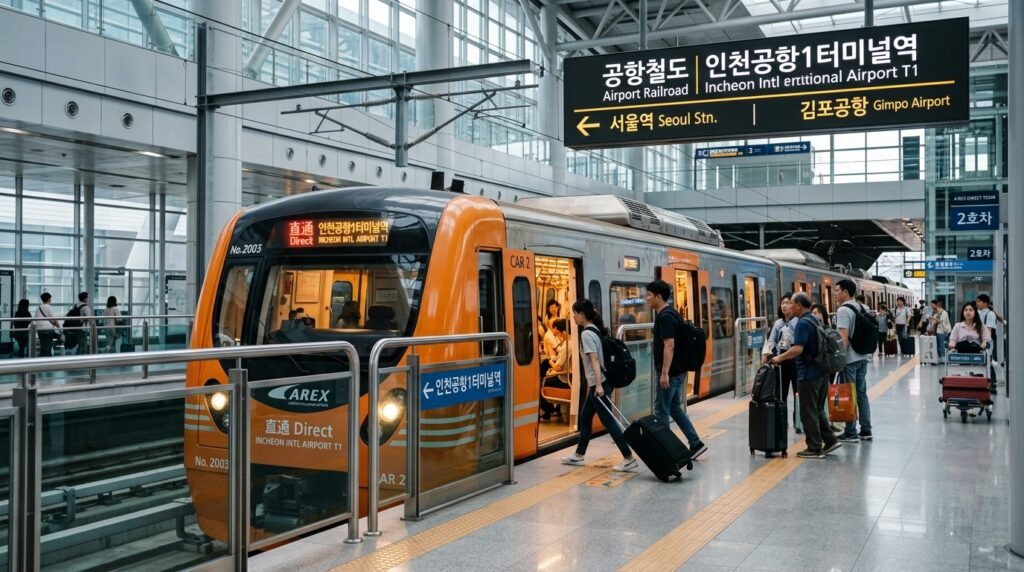
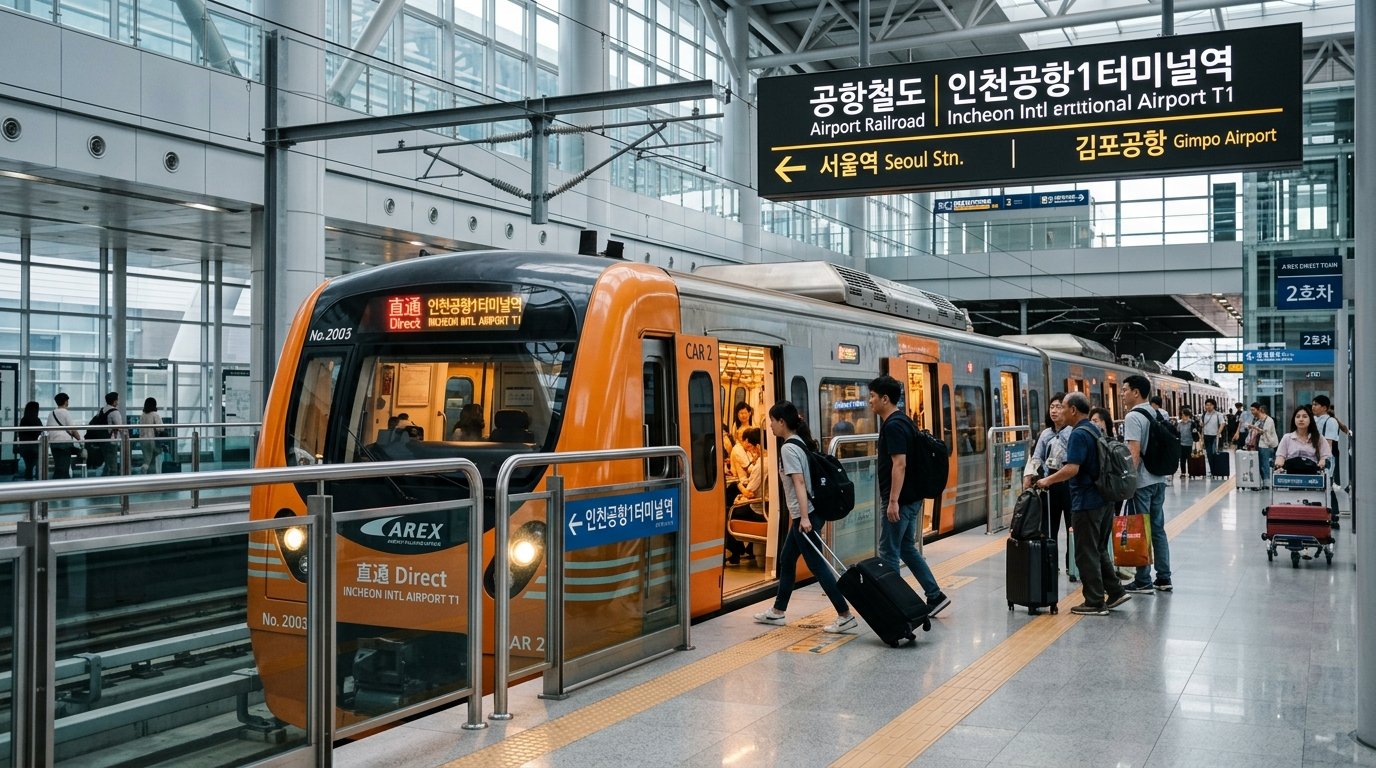
The AREX (Airport Railroad Express) Express Train is the flagship rail service connecting Incheon International Airport directly to Seoul Station without any intermediate stops. This bright orange-themed train represents the fastest and most reliable way to bridge the distance, especially during peak traffic hours when the highways leading into the city are heavily congested. The journey takes approximately 43 minutes from Terminal 1 and about 51 minutes from Terminal 2.
One of the primary benefits of the Express Train is the guaranteed seating. Each ticket corresponds to a specific assigned seat, meaning you will never have to stand during your journey after a long, exhausting flight. The carriages are fully air-conditioned, equipped with free Wi-Fi, and feature comfortable reclining seats. Furthermore, there are spacious dedicated luggage racks near the doors, making it highly convenient for international travelers carrying large suitcases. The trains even have clean restrooms on board, which is a rare feature for short-haul commuter lines.
Historically, fares were approximately KRW 9,500 for the Express service as of 2024, but you should always check the official AREX website for current fares and up-to-date timetables. Trains run roughly every 40 minutes. If your final destination is near Seoul Station, or if you don’t mind a brief taxi or subway ride from there to reach your hotel, this is undeniably the premier choice for speed and comfort.
AREX All-Stop Train
Unlike its Express counterpart, the AREX All-Stop Train (distinguished by its blue color scheme) stops at over a dozen stations between the airport and Seoul Station. This includes major transit hubs like Gimpo International Airport, Digital Media City, and Hongik University (Hongdae). The journey to Seoul Station takes about 60 to 66 minutes, making it slightly slower but significantly cheaper.
The All-Stop Train operates essentially like a standard subway line. There are no reserved seats, meaning you might have to stand if the train is busy (especially during commuter rush hours), and luggage storage is simply placing your bags next to you or above the seats if they fit. Historically, fares were approximately KRW 5,150 as of 2024. Again, check the official AREX website for current fares and schedules.
For budget-conscious travelers or those staying in neighborhoods directly serviced by this line, such as Hongdae or Mapo, the All-Stop train is arguably the best option. It avoids the need to travel all the way to Seoul Station only to backtrack via another subway line, saving you both time and money.

Airport Limousine Buses
For many travelers, the thought of navigating subway stairs with 25-kilogram suitcases is a nightmare. This is where the extensive network of Airport Limousine Buses shines. These buses provide direct, single-seat rides from the terminals at Incheon Airport to hundreds of major hotels and transit hubs across Seoul.
Do not let the word “bus” fool you; these vehicles are designed for premium comfort. They feature incredibly comfortable, wide recliners (often in a 2-1 seating configuration), ample legroom, and large windows for enjoying your first glimpses of the city skyline. Most importantly, the driver will load your heavy luggage into the undercarriage storage compartment and hand you a numbered claim ticket. You can simply relax in air-conditioned comfort until your stop is announced in multiple languages, including English, Japanese, and Chinese.
While the journey typically takes 60 to 90 minutes depending on traffic conditions and your exact destination, the door-to-door convenience is unparalleled. Popular routes include the 6001 and 6015 heading to Myeongdong, and the 6009 servicing Gangnam. If you haven’t yet decided on your accommodation, our comprehensive guide on where to stay in Seoul can help you choose a neighborhood well-served by these direct bus routes.
Taxis
Taxis offer the ultimate point-to-point convenience without having to decipher bus routes or subway maps. Once you clear customs and step outside the terminal building, you will find clearly marked taxi ranks categorized into Standard, Deluxe, and Jumbo (International) taxis. A standard taxi to central Seoul will typically cost between KRW 60,000 and KRW 80,000, plus expressway toll fees (around KRW 6,600), which the driver will add to the final meter price.
Deluxe taxis (usually black with a yellow sign on the roof) are more expensive but offer more space in the backseat, a higher standard of service, and drivers who are more likely to speak some English and drive more smoothly. Jumbo taxis are ideal for groups of up to 8 people or travelers with excessive luggage that won’t fit in a standard sedan trunk.
While taxis are available 24 hours a day, keep in mind that a 20% to 40% late-night surcharge applies to standard taxis between 22:00 and 04:00. It is highly recommended to have your hotel’s name and address written in Korean or pinned on a digital map on your phone to show the driver, as English proficiency can vary wildly.
Private Transfers
For a completely stress-free arrival, nothing beats a pre-arranged private transfer. A professional driver will monitor your flight’s arrival time, wait for you in the arrivals hall holding a personalized name board, assist you with your luggage, and drive you directly to your accommodation in a comfortable, climate-controlled vehicle.
This option is particularly beneficial for large families, corporate travelers, or anyone arriving after a gruelling 14-hour long-haul flight who simply wants to avoid the cognitive load of navigating public transport in a new country. You can easily Check private Incheon Airport transfers to see vehicle options ranging from standard luxury sedans to spacious multi-passenger vans.
While this is generally the most expensive option, the peace of mind, guaranteed price (with no hidden toll fees or traffic-related meter jumps), and seamless experience often justify the cost, especially when the price is split among a group of travelers.
Incheon Airport to Myeongdong
Myeongdong is one of the most popular areas for tourists, famous for its bustling street food stalls, endless cosmetics shopping, and highly central location. To travel from Incheon Airport to Myeongdong, you generally have two excellent choices depending on your luggage situation.
The first is the Airport Limousine Bus (Routes 6001 or 6015), which drops you right at the edge of the pedestrian zones or directly in front of major hotels. This is usually the preferred method due to the convenience of having your luggage handled for you. The bus takes about 70-80 minutes depending on traffic.
The second option is taking the AREX All-Stop Train to Seoul Station, and then transferring to Subway Line 4 for a quick two-stop ride to Myeongdong Station. This is slightly faster and cheaper but requires hauling your luggage through the expansive Seoul Station transfer corridors, which can involve walking for several minutes between platforms. Once you arrive, exploring the area is a joy. If you are still comparing vibrant Asian megacities for your broader itinerary, reading up on Tokyo vs Seoul might give you interesting perspectives on Myeongdong’s unique, fast-paced energy.
Incheon Airport to Hongdae
Hongdae, known for its youthful indie culture, vibrant nightlife, and proximity to several major universities, is incredibly easy to reach from the airport. The absolute best way to travel from Incheon Airport to Hongdae is via the AREX All-Stop Train.
The blue All-Stop train goes directly from the airport to Hongik University Station without requiring any subway transfers. The journey takes roughly 50 minutes and drops you right in the heart of the district. Because it’s a direct, single-seat subway ride, there is very little reason to take a bus or taxi unless you have an extraordinary amount of luggage or arrive after the trains have stopped running for the night.
Incheon Airport to Gangnam
Located south of the Han River, Gangnam is Seoul’s upscale business, medical tourism, and entertainment district. Reaching Gangnam from the airport takes slightly longer due to the geographic distance across the vast city.
The Airport Limousine Bus (such as Route 6009) is generally the most straightforward option, delivering you directly to major hotels and transit hubs in the district in about 80-90 minutes. If you prefer the predictability of the train, you can take the AREX All-Stop train to Gimpo Airport Station, transfer to Subway Line 9 (an express train line), and ride it straight into the Gangnam area. This train method avoids the notorious traffic congestion on the Olympic Expressway and can be significantly faster during rush hour.

Late-Night Arrivals
If your flight lands after 22:30, you will likely miss the last AREX trains and the regular daytime airport buses. Navigating late-night transport requires a bit of pre-planning, as options are much more limited.
Incheon Airport operates a limited network of late-night buses (often prefixed with an ‘N’) that run to major hubs like Seoul Station and the Gangnam Express Bus Terminal. These buses run at specific intervals between midnight and 04:00. From the drop-off point in Seoul, you will likely need to take a night taxi to your final hotel, as the local subways will also be closed.
Alternatively, taxis are available 24 hours a day at the airport ranks, though a significant night surcharge applies. If you are arriving late, this is arguably the best time to have booked a private transfer in advance to avoid waiting in long taxi queues or deciphering night bus schedules when you are thoroughly exhausted.
Families and Heavy Luggage
Traveling with small children, strollers, and multiple large suitcases significantly changes the transport calculus. Navigating the Seoul subway system, while incredibly efficient and modern, can involve long walks between transfer lines, crowded carriages, and occasional struggles finding elevators at older stations.
For families, the Airport Limousine Bus or a Private Van Transfer are strongly recommended. The bus allows you to stow your gear securely and sit together as a family. A private transfer is even better, offering door-to-door service without any walking or waiting in the elements. If you are still finalizing your family’s accommodation, you can Compare Seoul accommodation by neighbourhood to find family-friendly hotels that are easily accessible from the main airport routes.
Transport Cards and Payment (T-money)
Before you board the All-Stop train or any local city bus, you should acquire a transit card. The most popular is the T-money card, which can be purchased and loaded with cash at convenience stores (like CU, GS25, or 7-Eleven) located right inside the arrivals hall at Incheon Airport.
This smart card can be used to tap in and out of subways, buses, and even to pay for items in convenience stores and some taxis. Note that the AREX Express Train requires a specific, separate ticket (which can be purchased at the counter or machines), but the All-Stop train accepts the standard T-money card. Ensuring you are connected to the internet to check balances or navigate maps is vital, so remember to read our guide on the best eSIM for South Korea before you arrive, or simply Check South Korea eSIM options for instant connectivity upon landing.
Terminal 1 vs Terminal 2
It is crucial to know which terminal your airline uses. Incheon Airport has two massive terminals located about 15-20 minutes apart by shuttle bus or train. Terminal 2 is the newer, state-of-the-art facility, primarily serving Korean Air, Delta, Air France, and KLM, while Terminal 1 handles Asiana Airlines and the vast majority of international and budget carriers.
The AREX trains and most airport buses start their routes at Terminal 2 before making a stop at Terminal 1. This means passengers boarding at T2 get first pick of seats on the buses and trains. When returning to the airport from Seoul, pay close attention to the announcements to ensure you get off at the correct terminal, as making a mistake can cost you valuable time and stress before your flight.
Common Arrival Mistakes
One of the most frequent mistakes first-time visitors make is assuming the AREX Express Train is always the best option regardless of their destination. While it is the fastest way to Seoul Station, if your hotel is in Gangnam, taking the Express Train to Seoul Station only to spend another 45 minutes on the subway backtracking south is incredibly inefficient. Always map your specific route using localized tools like Naver Map or KakaoMap (Google Maps has limited walking direction functionality in South Korea due to security laws).
Another common error is forgetting that T-money transit cards must be recharged exclusively with cash (Korean Won) at station machines. You cannot use foreign credit cards to top up transit cards at subway stations, so always withdraw or exchange a small amount of cash at the airport before heading into the city.
To help organize your entire journey without missing these critical details, consider using our comprehensive trip planner to map out your transit nodes, daily schedules, and must-see attractions well in advance.
Returning from Seoul to Incheon Airport
When your trip concludes, getting back to the airport requires the same considerations in reverse. One incredible advantage of taking the AREX Express Train back to the airport is the City Airport Terminal service available exclusively at Seoul Station.
If you are flying with certain partner airlines (like Korean Air or Asiana) and have purchased an Express Train ticket, you can actually check your heavy luggage and complete immigration procedures right at Seoul Station hours before your flight. You can then spend your remaining time exploring the city unburdened by bags, take the train to the airport when ready, and breeze straight through a dedicated fast-track security lane to the departure gates.
Final Decision Table
To summarize the complex choices, here is a quick, actionable decision matrix to help you finalize your choice for getting from the airport to the city:
| Traveler Profile / Destination | Best Transport Option |
|---|---|
| Solo traveler heading to Hongdae | AREX All-Stop Train |
| Couple heading to Myeongdong | Airport Limousine Bus |
| Business traveler to Seoul Station | AREX Express Train |
| Family of 4 with lots of luggage | Private Transfer / Jumbo Taxi |
| Arriving at 1:00 AM | Night Bus or Pre-booked Transfer |
Frequently Asked Questions
Is Uber available at Incheon Airport?
Uber operates in South Korea in partnership with local taxis (often branded as UT or Uber Taxi). You can use your standard Uber app to hail a ride from the airport, but it will essentially call a licensed local taxi rather than a private citizen’s car. The pricing will reflect standard taxi meter rates.
Do I need to book the AREX train in advance?
You do not strictly need to book in advance, as tickets can easily be purchased at the station kiosks upon arrival. However, booking the Express Train online ahead of time often secures a small discount and guarantees your seat during exceptionally busy holiday periods.
How do I find the official Incheon Airport website?
You can find comprehensive terminal maps, live flight statuses, and detailed facility information at the Incheon International Airport official portal, which is available in multiple languages.
Can I use Google Maps to navigate from the airport?
Google Maps provides decent transit directions for trains and buses from the airport, but it cannot provide walking directions within Seoul due to local data security laws. It is highly recommended to download Naver Map or KakaoMap for accurate, localized navigation once you hit the ground.
Conclusion
Navigating from Incheon Airport to Seoul does not have to be a stressful or confusing start to your South Korean adventure. The city’s transport infrastructure is truly world-class, heavily signposted in English, and remarkably punctual. Whether you prioritize the rapid transit of the AREX Express Train, the door-to-door convenience of an airport limousine bus, or the bespoke luxury of a private transfer, there is a perfect option tailored for every traveler’s needs.
Take a moment to review your hotel location on a map, assess your luggage situation realistically, and factor in your flight arrival time. Once you have made your transportation choice, you can sit back, relax, and look forward to the incredible food, rich culture, and historic sights that await you in dynamic Seoul. Safe travels!
Continue planning
Your most useful next steps
Move from reading to one clear travel decision.