
First Solo Trip Tips 2026: 9 Smart Rules for a Safe, Social, and Manageable Adventure
Affiliate Disclosure: This article contains affiliate links. If you book through them, we may earn a small commission at no extra cost to you. Tiny internet magic, basically.
Planning your first solo trip in 2026 sounds glamorous until you realize you are now the CEO, CFO, security department, snack manager, emotional support animal, and emergency decision-maker of your own tiny travel company. Congratulations. No board of directors. No travel buddy to blame. Just you, your passport, and your questionable confidence.
That is exactly why this guide exists. These first solo trip tips 2026 are not here to sell you the fantasy that solo travel is always magical, cinematic, and full of mysterious strangers who become lifelong friends over sunset cocktails. Sometimes solo travel is beautiful. Sometimes it is awkward. Sometimes you eat dinner alone beside a honeymoon couple and pretend your phone is extremely interesting. Character building, darling.
But done properly, your first solo trip can be one of the most useful travel experiences of your life. It teaches you how to make decisions, manage discomfort, meet people, protect your money, plan realistically, and enjoy your own company without turning every minor inconvenience into a personal TED Talk.
In 2026, solo travel is also not some niche little hobby for people who own linen pants and quote travel influencers. Travel demand across Asia remains strong, with regional tourism flows, domestic travel surges, and renewed interest in closer, easier destinations shaping how people plan trips. At the same time, beginner solo travelers are still asking the same emotionally loaded questions online: Is this destination safe? Should I stay in a hostel? Will I feel lonely? Am I overplanning? Am I underplanning? Will I be robbed, bored, or accidentally join a pub crawl I deeply regret?
So let us cut the nonsense. These first solo trip tips 2026 are practical, beginner-friendly, commercially useful, and designed for travelers who want independence without chaos. Freedom is great. Freedom with a working SIM card, a decent hotel, and a plan for airport arrival is better.
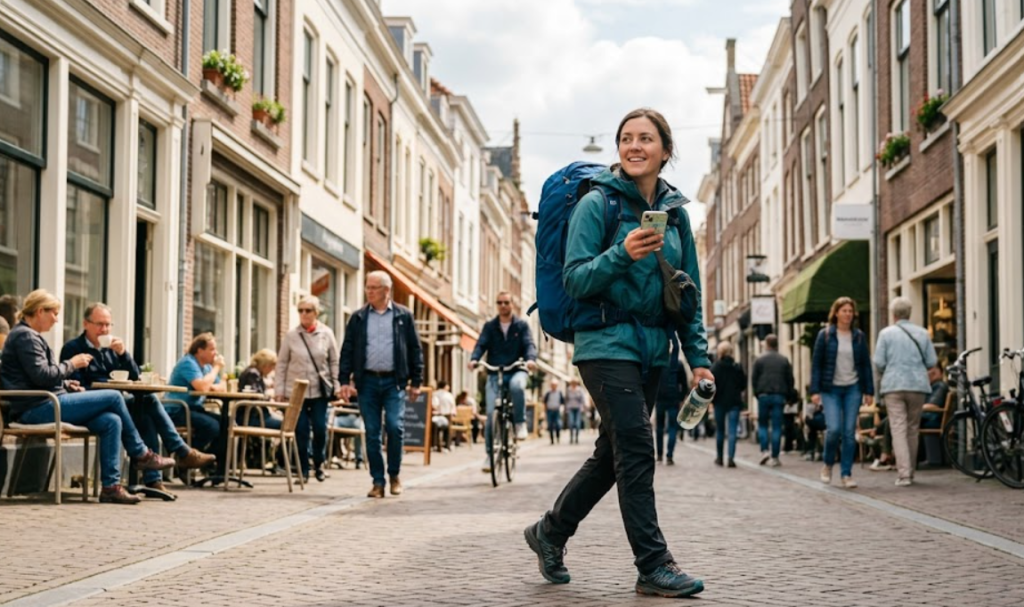
Why Your First Solo Trip Should Be Manageable, Not “Epic”
The biggest mistake beginners make is trying to make their first solo trip look impressive. They want five cities, three countries, two mountain hikes, one island escape, and a spiritual awakening before checkout. Very cute. Also completely unnecessary.
Your first solo trip should not be designed to impress Instagram, your ex, your coworkers, or that one friend who says “Europe is easy, bro” because he once spent three days in Amsterdam and survived on fries. Your first solo trip should be designed to reduce friction.
That is the core idea behind these first solo trip tips 2026: keep the trip safe, social, and manageable. Not boring. Not timid. Manageable. There is a difference.
A manageable solo trip gives you room to make mistakes without the entire plan collapsing like a budget airline tray table. It gives you time to understand transport, check into accommodation during daylight, join one or two social activities, and recover when your confidence temporarily leaves your body because you boarded the wrong train.
For your first solo trip, choose simple over dramatic. One country is usually better than three. One region is usually better than a cross-continent speed run. Fewer bases are better than changing hotels every night. A slower trip may feel less glamorous on paper, but it is usually more enjoyable in real life. Shocking, I know: vacations are better when they do not feel like unpaid logistics internships.
For more help building a realistic schedule, read this internal guide: AI Trip Planner for Realistic Travel Itineraries. Use it before you create one of those itinerary crimes where breakfast is at 8:00, museum at 8:17, temple at 8:43, lunch at 9:02, and emotional breakdown at 9:11.
1. Pick the Right First Destination, Not the Most Impressive One
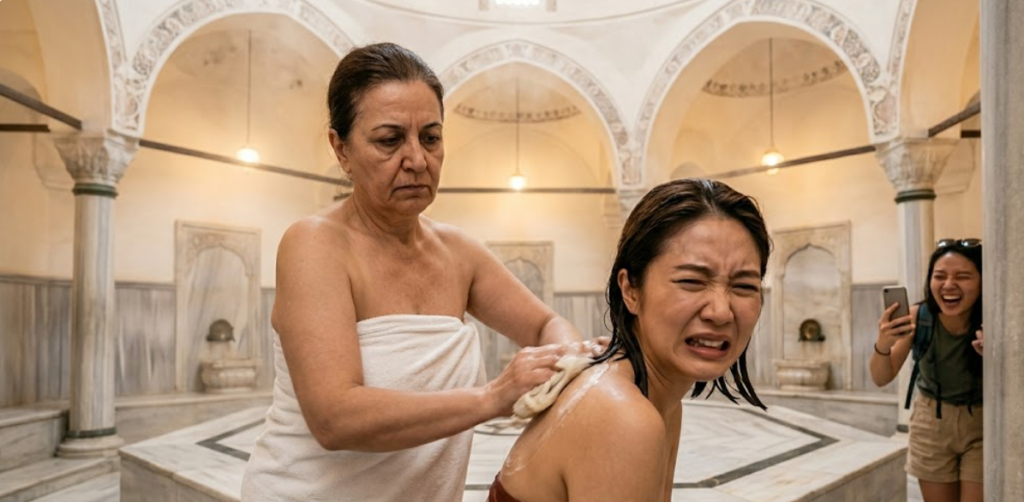
The first rule of first solo trip tips 2026 is simple: your first destination should match your confidence level, not your fantasy version of yourself.
A beginner-friendly solo destination usually has five things: good public transport, safe and well-reviewed neighborhoods, plenty of accommodation options, easy mobile connectivity, and enough traveler activity that you can meet people without chasing strangers like a confused golden retriever.
Do not choose a destination just because it looks “authentic.” That word has caused enough travel suffering already. Authentic can be wonderful. Authentic can also mean complicated transport, limited English support, cash-only systems, poor late-night arrival options, and you standing outside a closed guesthouse wondering whether this is personal growth or poor planning.
For a first solo trip, aim for places that are easy to navigate and forgiving for beginners. Major cities, established beach towns, popular cultural hubs, and well-connected regional destinations are usually better than remote places with weak transport and low tourist infrastructure.
Examples of strong first-solo-trip destination types include:
- One major city plus nearby day trips: Easy transport, more accommodation choices, less packing drama.
- A calm beach town with tours: Relaxed pace, social activities, and fewer logistics.
- A cultural city with walking tours: Good for meeting people without forcing hostel nightlife.
- A regional hub in Asia or Europe: Easy flights, strong tourism infrastructure, and plenty of beginner-friendly routes.
Bad first-solo-trip choices usually involve complicated border crossings, poor transport, heavy nightlife pressure, extreme weather, political instability, or isolated areas where one mistake becomes expensive. Adventure is nice. Avoiding avoidable nonsense is nicer.
Before booking, check official travel advisories from your country or trusted government sources. The U.S. Department of State travel advisory system, GOV.UK foreign travel advice, and Australia’s Smartraveller pages are useful starting points. This is not paranoia. This is basic homework. The glamorous term is “risk management.” The honest term is “please do not wing it like a fool.”
2. Follow the One-Country First Rule
Here is one of the most important first solo trip tips 2026: choose one country for your first solo trip unless you already travel frequently and handle logistics well.
Yes, technically you can do Thailand, Vietnam, Cambodia, Malaysia, and Singapore in two weeks. You can also eat only airport sandwiches for dinner and call it cultural immersion. Possible does not mean smart.
The one-country first rule keeps things simple. You learn one currency, one transport style, one SIM setup, one basic etiquette system, and one general safety environment. Your brain has enough to process already. Do not make it run a regional operations center on day one.
A good beginner solo trip could look like this:
- 7 days: One city plus two day trips.
- 10 days: Two bases maximum.
- 14 days: Three bases if transport is simple.
Notice what is missing? Seven cities in nine days. Because that is not travel. That is luggage relocation with occasional sightseeing.
For your first solo trip, your goal is not to see everything. Your goal is to build confidence. After you complete one successful solo trip, you can become more ambitious. Earn complexity. Do not start with it.
This is why first solo trip tips 2026 need to be realistic rather than motivational fluff. The internet loves telling people to “just go.” Lovely slogan. Terrible operational plan. Go, yes. But go with a structure that does not punish you for being new.
3. Book the First Two Nights Before You Arrive
Do not land in a new country with no accommodation booked because you want to be “flexible.” That is not flexibility. That is administrative laziness wearing a backpack.
For your first solo trip, book at least the first two nights in advance. Ideally, book somewhere central, well-reviewed, and easy to reach from the airport or train station. Your first night is not the time to experiment with a mysterious guesthouse located “just 20 minutes from the center,” where “20 minutes” means by scooter, in daylight, with a local uncle named Somchai guiding you through an alley.
Use proper booking platforms, read recent reviews, and filter for safety, location, cleanliness, and staff helpfulness. Look especially for comments from solo travelers. A hotel may be excellent for couples and terrible for solo beginners if it is isolated, silent, or far from transport.
For hotel and guesthouse bookings, compare options here:
Compare beginner-friendly hotels on Booking.com
Compare hotels and flights on Trip.com
When comparing places, use this simple checklist:
- Rating above 8.0, preferably 8.5+.
- Recent reviews within the last three months.
- Comments mentioning safe location.
- Easy access to public transport.
- Clear check-in instructions.
- 24-hour reception if arriving late.
- Good Wi-Fi, because “digital detox” is cute until your maps stop working.
One of the least glamorous but most useful first solo trip tips 2026 is this: your first accommodation should reduce stress, not maximize savings. Saving $8 by staying far away from
4. Understand the Safe-Social Accommodation Spectrum
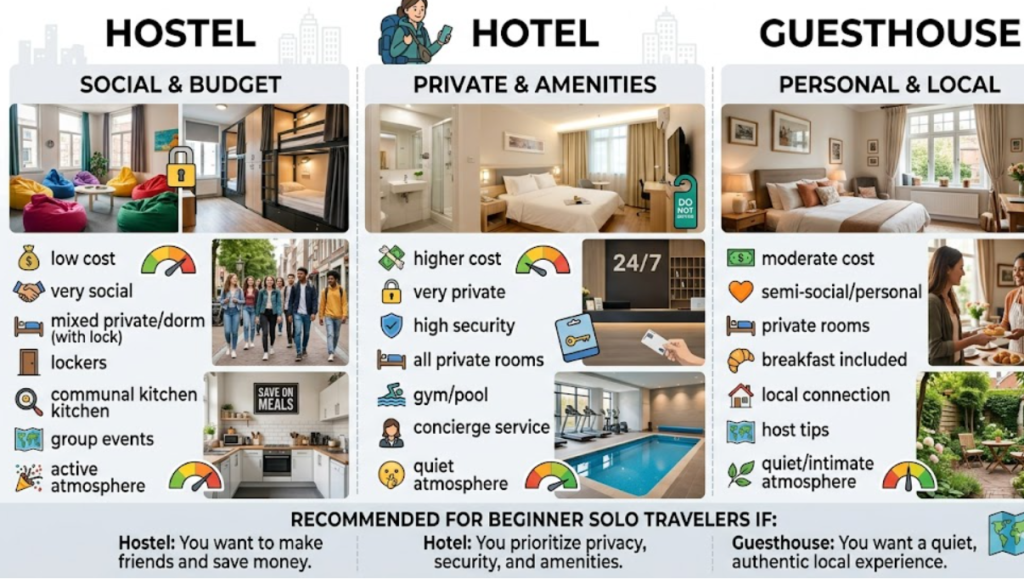
Accommodation is not just where you sleep. On a solo trip, it controls your safety, social life, budget, convenience, and mental comfort. Choose badly, and your trip becomes a daily negotiation with regret.
The three main beginner options are hostels, hotels, and guesthouses. None is automatically best. Each has strengths and weaknesses.
Hostel vs Hotel vs Guesthouse
Hostels are great if you want easy social contact, group tours, shared meals, and lower prices. They are also risky if you hate noise, need privacy, or have low tolerance for people who think playing guitar in common areas is a personality.
Hotels are better for privacy, sleep quality, security, and comfort. They are weaker for meeting people unless you join tours or activities outside the hotel. Hotels are excellent for your first two nights, especially if you are nervous.
Guesthouses sit in the middle. They can feel local, warm, affordable, and personal. But quality varies wildly. Some are charming. Some are just someone’s spare building with Wi-Fi and optimism.
The smartest first solo trip setup is often mixed:
- First two nights in a hotel or highly rated private room.
- Middle nights in a social hostel or guesthouse.
- Final night near the airport or transport hub.
This gives you comfort when you arrive, social energy once you settle in, and reduced stress before departure. Balanced. Sensible. Almost suspiciously adult.
These first solo trip tips 2026 matter because many beginners think solo travel means choosing between total isolation and chaotic party hostels. False. You can be social without sleeping above someone who returns at 3:00 a.m. smelling like poor decisions.
Recommended anti-theft day bag for solo travelers.
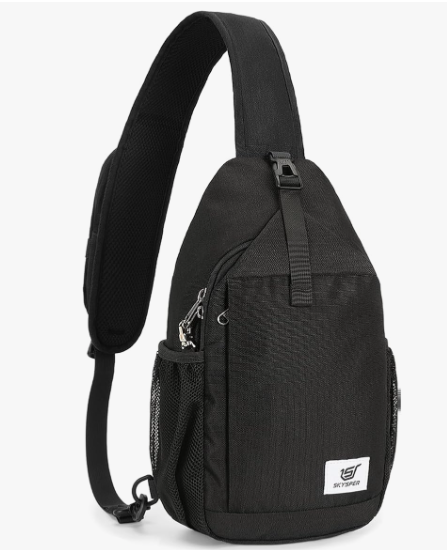
A small anti-theft day bag is useful for first-time solo travelers because it keeps your passport copy, phone, wallet, power bank, and daily essentials organized. Do not carry your entire life in your day bag. This is sightseeing, not migration.
5. Arrive During Daylight Whenever Possible
One of the most boring first solo trip tips 2026 is also one of the most important: arrive during daylight.
Daylight arrival makes everything easier. Transport feels less intimidating. Streets are busier. Reception desks are fully staffed. You can spot landmarks. You can buy a SIM or eSIM setup calmly. You can find food without entering survival mode. Most importantly, you can make better decisions because you are not tired, hungry, and emotionally dramatic after a long flight.
Official travel safety guidance often recommends planning transport and accommodation before arrival, especially for solo travelers. That advice exists because arriving unprepared at night is where small problems multiply. A closed reception becomes a crisis. A wrong taxi becomes expensive. A dead phone becomes a horror movie, minus the soundtrack.
When booking flights or trains, pay extra attention to arrival time. The cheapest ticket is not always the best ticket. A flight landing at 1:30 a.m. may save money upfront but cost more in taxis, stress, and questionable life choices.
For late arrivals, book an airport transfer in advance. Yes, it may cost more than public transport. No, this is not the moment to prove you are a budget warrior. Your first night in a new place should be smooth, not a scavenger hunt.
Use this rule: if you arrive after 9:00 p.m., pre-arrange transport. If you arrive after midnight, book a hotel with 24-hour reception and message them your arrival time. If your flight lands after midnight and your accommodation says “self check-in is easy,” read the reviews very carefully. Easy for whom, Brenda?
6. Use an eSIM Before You Land
A working phone is not optional on your first solo trip. It is your map, translator, booking assistant, emergency tool, bank access, ride-hailing device, and occasionally your fake social shield when you do not want to talk to someone. Powerful little rectangle.
Set up mobile data before you land if possible. eSIMs are one of the best tools for beginner solo travelers because you can activate data quickly without hunting for a SIM counter while half-asleep at the airport.
For eSIM options, compare these:
Get an eSIM with Airalo
Get an eSIM with Saily
Before departure, download offline maps, save your hotel address in the local language, screenshot your booking confirmation, and save emergency contact numbers. Do not rely on airport Wi-Fi. Airport Wi-Fi has the emotional stability of a toddler with jet lag.
Another one of the non-negotiable first solo trip tips 2026: share your live location with someone you trust during travel days. Not every minute of your trip. That is excessive. But airport arrival, hotel check-in, long transfers, and late-night movements should not be secret missions.
Recommended: Compact Power Bank
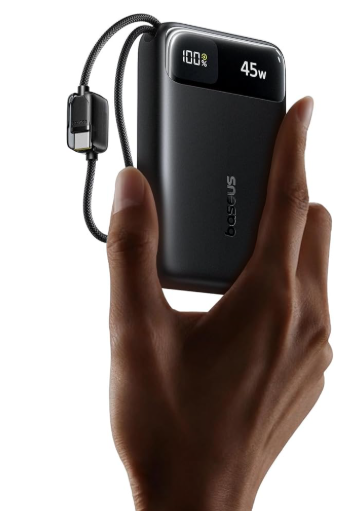
Pack a compact power bank and keep it in your carry-on. Check current airline and airport rules before flying, because lithium battery restrictions can vary. The basic point is simple: your phone should not die when you are navigating alone in a new city. That is not adventure. That is poor battery management with consequences.
7. Build a Safety Setup Before You Need It
Beginner solo travelers often think safety means reacting well when something goes wrong. Wrong. Safety means setting up systems so fewer things go wrong in the first place.
These first solo trip tips 2026 are not about being scared. They are about being difficult to mess with. There is a difference.
Create a simple safety setup before you travel:
- Save digital and offline copies of your passport, visa, insurance, and bookings.
- Keep one backup bank card separate from your main wallet.
- Use a small amount of cash, not a dramatic money belt stuffed like a cartoon treasure pouch.
- Check your accommodation route before arrival.
- Avoid sharing your exact hotel or room number with strangers.
- Use ride-hailing apps or official taxis when arriving late.
- Trust your discomfort. You do not need a courtroom-level reason to leave a place.
Also, stop posting your real-time location publicly. Post later. The sunset will still look smug and golden after you leave.
Travel insurance is another boring adult item that becomes very interesting the moment your bag disappears, your flight gets cancelled, or you need medical help abroad. For first-time solo travelers, insurance is not a luxury. It is part of the basic safety setup.
Compare travel insurance with Ekta Traveling
Read the exclusions before buying. Not the cute marketing summary. The actual policy wording. Standard travel insurance may not cover everything you assume it covers. Assumptions are expensive. Policy documents are boring. Choose your pain.
8. Meet People Without Forcing Party-Hostel Energy
One of the biggest fears around solo travel for beginners is loneliness. Fair. Solo travel can feel lonely, especially during meals, evenings, and travel days. But meeting people does not require becoming a party-hostel goblin who survives on instant noodles and group shots.
These first solo trip tips 2026 focus on low-pressure social options. You do not need to make best friends. You just need enough human connection to avoid feeling like a ghost with a backpack.
Good beginner-friendly ways to meet people include:
- Free walking tours.
- Small-group food tours.
- Hostel social dinners, even if you are not sleeping in a dorm.
- Cooking classes.
- Day trips with shared transport.
- Self-guided audio tours in busy areas.
- Coworking cafes if you are working while traveling.
Small-group tours are especially useful because they create instant structure. You do not have to approach random strangers with the energy of a networking event. You just show up, follow the guide, ask someone where they are from, and pretend you are naturally social. Works beautifully.
For tours and activities, check:
Find beginner-friendly tours on Klook
Try self-guided audio tours with WeGoTrip
A smart first solo trip usually includes one planned social activity every two days. Not every hour. You are traveling solo, not auditioning for a friendship reality show.
Recommended Product – Travel Door Stop Alarm
Recommended portable hotel room safety accessory for solo travelers.
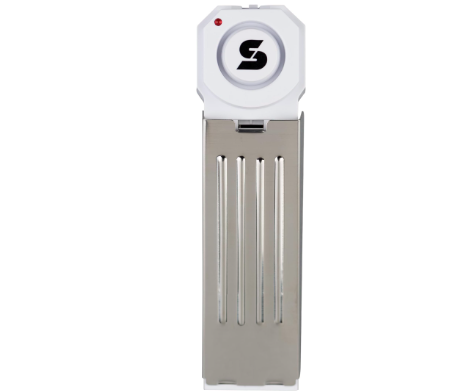
A small room-safety accessory can help some solo travelers sleep better, especially in budget accommodation. Just make sure it is legal, non-damaging, and suitable for the door type. Peace of mind is useful. Turning your hotel room into a spy bunker is unnecessary.
9. Budget Like a Real Person, Not a Travel Influencer With “Mystery Income”
Let us be honest. A lot of online solo travel advice is written by people who apparently travel for six months, eat smoothie bowls daily, stay near the beach, and somehow never discuss money. Fascinating. Suspicious. Possibly sponsored by generational wealth.
One of the most useful first solo trip tips 2026 is to build a budget that includes boring reality: airport transfers, mobile data, luggage storage, insurance, local transport, snacks, tips, laundry, and “I am too tired to be financially optimized today” meals.
Your first solo trip budget should have four layers:
- Fixed costs: flights, accommodation, visa, insurance.
- Daily costs: meals, coffee, transport, sightseeing, tours.
- Comfort costs: taxis, private room upgrades, laundry, luggage storage.
- Emergency buffer: medical needs, missed transport, replacement items, unexpected hotel changes.
Do not build your budget assuming every day will be perfect. You will have tired days. You will overpay once. You will buy something unnecessary because your brain says, “We are abroad, calories and budgets are imaginary.” Plan for human behavior, not fantasy behavior.
A smart beginner solo travel budget usually includes a 15% to 25% buffer above your expected cost. That does not mean you must spend it. It means your trip does not collapse because a taxi costs more than expected or your “budget hostel” feels like a social experiment funded by mildew.
If you are comparing hotels, flights, and bundled travel options, use both major booking platforms because prices and availability can vary:
Compare solo-friendly stays on Booking.com
Compare flights and hotels on Trip.com
Another practical note: do not book the cheapest accommodation unless the reviews clearly support it. Cheap is not always bad, but suspiciously cheap usually has a reason. Maybe it is far from everything. Maybe the walls are thinner than your patience. Maybe the “city view” is a parking lot having an identity crisis.
Among all first solo trip tips 2026, this one deserves respect: spend more on safety, location, and sleep. Save money on souvenirs, not on the place where you are unconscious for eight hours.
10. Use Airport Transfers Strategically, Especially on Arrival
Airport transfers are not always necessary. Sometimes public transport is easy, clean, safe, and affordable. Other times, the route from airport to hotel involves two trains, one bus, a 12-minute walk, and a final boss battle with a suitcase on broken pavement. Charming in theory. Annoying in real life.
For your first solo trip, the arrival transfer is the most important one. Departure is easier because by then you understand the city better. Arrival is when you are tired, disoriented, carrying luggage, and making decisions with airport lighting slowly deleting your soul.
Use a pre-booked transfer when:
- You land after 9:00 p.m.
- Your accommodation is far from public transport.
- You are carrying heavy luggage.
- You are arriving in a destination known for taxi scams.
- You are nervous and want a smoother first hour.
Book airport transfers here:
Compare airport transfers with GetTransfer
Book airport transfers with HolidayTaxis
One of the more underrated first solo trip tips 2026 is to screenshot your driver details, hotel address, and booking confirmation before takeoff. Do not assume mobile data will work instantly after landing. Technology loves betrayal.
If using taxis, choose official airport taxi counters or ride-hailing apps where legal and reliable. Avoid random drivers approaching you inside the terminal. A stranger saying “taxi, taxi, good price” is not a business plan you need to support.
11. Keep Your Itinerary Light Enough to Actually Enjoy
Beginner solo travelers often overpack their itinerary because empty time feels scary. They worry that if they leave free space, they will feel lonely, bored, or unsure what to do. So they book every museum, market, viewpoint, temple, cafe, food tour, and sunset spot until the trip becomes a spreadsheet with jet lag.
This is where first solo trip tips 2026 need to slap the itinerary out of your hand politely.
For your first solo trip, use the 2-1-1 rule:
- 2 planned activities per day maximum.
- 1 flexible backup option.
- 1 proper break.
That is it. Not eight activities. Not four neighborhoods. Not an “efficient route” that requires Olympic walking speed and monk-level digestion.
A good beginner day could look like this:
- Morning: walking tour or major attraction.
- Afternoon: lunch and one neighborhood wander.
- Evening: relaxed dinner, night market, or rest.
Notice the presence of rest. Revolutionary. Travel is more enjoyable when your legs do not feel like they have filed a complaint with HR.
For route building, use your internal planning tool here: AI Trip Planner. It is especially useful for testing whether your itinerary is realistic or whether you have accidentally created a punishment schedule with scenic views.
The smartest first solo trip tips 2026 all point toward the same truth: confidence grows when your plan has breathing space. Overplanning does not make you safer. It often makes you tired, late, and annoyed.
12. Learn the Art of Eating Alone Without Acting Weird About It
Solo dining terrifies many first-time solo travelers. Not because eating alone is actually dangerous, but because people imagine everyone in the restaurant is judging them. They are not. Most people are busy judging the menu, their date, the bill, or their own life choices.
Eating alone is a skill. Your first few meals may feel awkward. Then you realize it is peaceful. Nobody steals your fries. Nobody says, “Should we share?” and then takes 70% of the dish. Beautiful.
For your first solo trip, start with easy food environments:
- Food courts.
- Markets.
- Cafes.
- Counter seating restaurants.
- Casual local diners.
- Food tours.
A food tour is especially useful because it solves dinner, social connection, local knowledge, and decision fatigue in one neat package. You eat, learn, walk, talk, and avoid choosing a restaurant based only on a desperate Google rating scan.
For authentic culinary experiences with locals, check:
Book local food experiences with Eatwith
One of the most practical first solo trip tips 2026 is to plan your first dinner before you arrive. After a flight, your brain is not ready to evaluate restaurant neighborhoods. Pick one easy option near your hotel. Save it on your map. Done.
Also, carry one small snack. Hunger makes people stupid. Solo hunger makes people book overpriced room service and call it self-care. Sometimes it is self-care. Sometimes it is just poor snack planning.
13. Use Small-Group Tours as Training Wheels
There is no shame in using tours on your first solo trip. Some travelers act as if independent travel means you must personally decode every bus route, monument, menu, and historical tragedy by yourself. Please relax. You are on vacation, not competing in the International Backpacker Purity Olympics.
Small-group tours are excellent for solo travel for beginners because they provide structure without removing independence. You can join a walking tour, food tour, boat trip, museum tour, cooking class, or day trip, then return to doing your own thing afterward.
Use tours when:
- The destination has complex history or culture.
- The attraction is far from your accommodation.
- Public transport is confusing.
- You want to meet people casually.
- You feel nervous exploring a neighborhood alone.
For beginner-friendly activities and local experiences, browse:
Find day tours and activities on Klook
Find local events with TicketNetwork
For city walks without group commitment, self-guided audio tours are useful. You get context without following a flag-waving guide or pretending to enjoy group introductions.
Try self-guided city tours with WeGoTrip
Among all first solo trip tips 2026, this one is simple: do not confuse independence with doing everything the hard way. Smart travelers outsource complexity when it improves the trip.
14. Protect Your Money Like Someone Who Enjoys Having Money
Money safety is not glamorous, but neither is calling your bank from a hostel lobby because your only card has disappeared. First-time solo travelers need redundancy. Not paranoia. Redundancy.
Set up your money system before departure:
- Carry two bank cards and keep them separately.
- Use a small amount of emergency cash.
- Enable transaction alerts.
- Tell your bank about travel if needed.
- Use ATMs inside banks, malls, or secure areas.
- Avoid carrying your passport and all cards together.
- Use a digital wallet where widely accepted.
Do not flash cash. Do not count money in public like you are auditioning for a robbery tutorial. Do not keep everything in one wallet. And please, do not store your emergency card in the same bag as your main card. That is not backup. That is a group booking for disaster.
A strong money setup is one of the least discussed first solo trip tips 2026, but it is critical because solo travelers do not have a companion’s spare card to rescue them. When you travel alone, your backup plan needs a backup plan.
Also, keep copies of important documents in secure cloud storage and offline on your phone. Use password protection where possible. Your phone should help you recover from problems, not create new ones because every document is scattered across 14 WhatsApp chats and one folder named “final final travel stuff.”
15. Pack Light, But Not Like a Minimalist Cult Member
Packing light is smart. Packing so light that you are washing socks in a sink every night like a tragic travel monk is optional and frankly unnecessary.
For your first solo trip, your luggage should be easy to carry by yourself. That is the rule. If you cannot lift it into a train rack, carry it up one flight of stairs, or walk 10 minutes with it, it is too much.
Pack around comfort, safety, and mobility:
- Comfortable walking shoes.
- One nicer outfit for dinner or events.
- Basic medicine kit.
- Power bank.
- Universal adapter.
- Copies of documents.
- Small day bag.
- Light layer for flights and buses.
Leave space for buying small items locally. You do not need to pack for every possible version of yourself. The beach version, mountain version, nightclub version, emergency yoga version, and “what if I meet royalty” version do not all need luggage space.
One of the most honest first solo trip tips 2026 is this: your bag becomes your responsibility every single minute. No partner, friend, cousin, or unlucky sibling is there to “just watch this for a second.” Pack accordingly.
16. Know When to Choose Hotels Over Hostels
Hostels are useful, but the internet oversells them as the default answer for solo travelers. They are not always the best choice. Some people love dorms. Some people tolerate them. Some people enter one dorm room and immediately understand the value of walls.
Choose a hotel or private room when:
- You are arriving late.
- You are sick or exhausted.
- You have valuables or work equipment.
- You need proper sleep.
- The destination has safety concerns.
- You are staying only one or two nights.
Choose a hostel when:
- You want easy social interaction.
- You are staying in a strong backpacker destination.
- The hostel has excellent recent reviews.
- There are organized activities.
- You can book a private room inside a social hostel.
The ideal beginner setup is often a private room in a social hostel or guesthouse. You get people when you want them and a door when humanity becomes too much. Elegant solution.
Use accommodation reviews properly. Search within reviews for “solo,” “safe,” “location,” “noise,” “clean,” “staff,” and “female traveler” if relevant. Reviews tell you what the marketing copy politely hides.
This is one of those first solo trip tips 2026 that saves both money and sanity: the cheapest bed is not always the best value. Bad sleep ruins good destinations.
17. Keep Your First Trip Social, But Not Dependent on Other People
Solo travel becomes disappointing when beginners expect to meet amazing people every day. You might. You also might meet nobody interesting for 48 hours, and that is not a tragedy. That is travel behaving normally.
Design your trip so it works even if you do not make friends. Book activities you genuinely want to do. Choose cafes, museums, beaches, neighborhoods, and day trips you would enjoy alone. Social moments should improve the trip, not hold it hostage.
Healthy solo travel has three zones:
- Alone time: wandering, cafes, museums, beach time, journaling, shopping.
- Light social time: walking tours, shared breakfasts, group transport, classes.
- Deeper social time: dinners, day trips, repeated meetups, travel buddies.
Do not force instant best friendships. You are not required to attach yourself to the first person who says they are also traveling alone. Be friendly, not desperate. Desperation has a smell, and it is not duty-free perfume.
One of the healthiest first solo trip tips 2026 is to plan one social opportunity every other day. That gives you connection without turning your trip into a networking event with laundry.
18. Buy Travel Insurance and Actually Read What It Covers
Travel insurance is boring until it is suddenly the most important document you own. Delayed flight? Lost bag? Medical issue? Emergency change? That boring PDF starts looking extremely attractive.
For solo travel for beginners, insurance matters more because you do not have a companion to help manage logistics if something goes wrong. You need coverage, emergency contacts, claim instructions, and a basic understanding of what is excluded.
Compare travel insurance here:
Compare travel insurance with Ekta Traveling
Before buying, check:
- Medical coverage limits.
- Emergency evacuation coverage.
- Trip cancellation and interruption terms.
- Baggage delay and loss coverage.
- Adventure activity exclusions.
- Alcohol-related exclusions.
- Pre-existing condition rules.
Also check flight disruption support. If your flight is delayed or cancelled, compensation services may help in eligible cases:
Check flight compensation eligibility with Compensair
Check flight compensation support with AirHelp
One of the clearest first solo trip tips 2026 is this: do not buy insurance based only on price. Cheap insurance with weak exclusions is just an expensive decoration for your inbox.
19. Avoid the Classic First Solo Trip Mistakes
Most first solo trip mistakes are predictable. That is good news, because predictable mistakes can be avoided. You do not need to learn everything through suffering. Growth is nice. Preventable stupidity is optional.
Here are the mistakes to avoid:
- Booking too many destinations: You spend more time moving than enjoying.
- Arriving late with no plan: Stressful, unsafe, and completely avoidable.
- Ignoring neighborhood research: A great hotel in a bad location is not great.
- Overpacking: You carry the consequences every day.
- Depending on Wi-Fi only: Bad idea. Get mobile data.
- Trying to be social every night: Exhausting and unnecessary.
- Skipping insurance: False economy with dramatic downside.
- Posting real-time locations publicly: Stop making things easy for weird people.
- Not trusting your instincts: Leave early if something feels off.
The most damaging beginner mistake is trying to travel like someone more experienced. Your first solo trip is not the time to copy a full-time backpacker, a luxury influencer, or a Reddit user who claims every destination is safe because “nothing happened to me.” That is not data. That is one person with survivorship bias and possibly very lucky shoes.
Use first solo trip tips 2026 that fit your actual comfort level. A good trip stretches you slightly. It should not throw you into chaos and call it transformation.
20. First Solo Trip Checklist for 2026
Here is your simple checklist before departure. Save it, screenshot it, print it, tattoo it on your travel planning brain. Whatever works.
- Choose one beginner-friendly country or region.
- Book the first two nights in a safe, central area.
- Check government travel advisories.
- Arrive during daylight where possible.
- Pre-book airport transfer for late arrivals.
- Set up eSIM or mobile data before landing.
- Download offline maps.
- Save hotel address in English and local language.
- Share key itinerary details with someone trusted.
- Carry two payment cards separately.
- Buy travel insurance and read exclusions.
- Pack light enough to carry everything yourself.
- Plan one social activity every two days.
- Keep the itinerary realistic.
- Leave free time without guilt.
This checklist works because it removes the biggest beginner risks: confusion, isolation, overplanning, poor transport decisions, weak safety setup, and bad accommodation choices.
Strong first solo trip tips 2026 are not about making your trip perfect. Perfect trips do not exist. The goal is to make your trip resilient. If something goes wrong, your plan should bend, not break.
Final Thoughts: Your First Solo Trip Should Build Confidence, Not Break You
Your first solo trip in 2026 does not need to be dramatic. It does not need to be long. It does not need to include five countries, three life lessons, and a sunrise photo caption about finding yourself. Please leave “finding yourself” alone for a minute. Start with finding your hotel.
The best first solo trip is safe enough to relax, social enough to feel connected, and manageable enough that you do not spend every day solving logistical puzzles. That is the sweet spot.
Use these first solo trip tips 2026 as a practical framework. Pick the right destination. Book smart accommodation. Set up mobile data. Protect your money. Use tours when helpful. Keep your itinerary light. Eat alone without being weird about it. Buy travel insurance. Trust your instincts. And above all, stop trying to make your first trip look impressive. Make it work.
Because once your first solo trip works, everything changes. You realize you can arrive in a new place, make decisions, solve problems, meet people, enjoy your own company, and return home with better confidence than you had when you left.
That is the real win. Not the perfect photo. Not the number of countries. Not the dramatic airport selfie. The win is knowing you can handle yourself.
And honestly, that is far more useful than another fridge magnet.
Recommended Booking Resources for Your First Solo Trip
Ekta Traveling — travel insurance comparison.
Booking.com — compare hotels, guesthouses, and private rooms.
Trip.com — compare flights, hotels, and travel deals.
Airalo — eSIM options for mobile data abroad.
Saily — alternative eSIM provider for international travel.
GetTransfer — pre-booked airport and city transfers.
Klook — tours, activities, airport transfers, and attraction tickets.
FAQs: First Solo Trip Tips 2026
What is the best destination for a first solo trip in 2026?
The best destination for a first solo trip in 2026 is somewhere safe, easy to navigate, well-connected, and full of beginner-friendly accommodation and activities. Choose one country or one region first, not a five-country itinerary designed by someone allergic to rest.
How long should my first solo trip be?
For most beginners, 5 to 10 days is ideal. It is long enough to build confidence but short enough that you do not feel trapped if solo travel feels emotionally weird at first. A weekend is too rushed, and one month may be too much for a first attempt.
Is solo travel safe for beginners?
Solo travel can be safe for beginners if you choose the right destination, stay in a central area, arrive during daylight, keep mobile data active, avoid risky nightlife decisions, and share your basic itinerary with someone you trust. Safety is not about being fearless. It is about not being careless.
Should I stay in a hostel or hotel on my first solo trip?
For your first solo trip, a hotel or private room is usually better for the first two nights because it gives you comfort, privacy, and easier arrival. After settling in, you can try a social hostel, guesthouse, or hostel private room if you want to meet people without sacrificing sleep like a martyr.
How do I meet people while traveling solo?
The easiest ways to meet people while traveling solo are walking tours, food tours, cooking classes, day trips, hostel social events, and small-group activities. Do not depend only on random conversations. Structured activities make socializing easier and less awkward.
How much should I budget for a first solo trip?
Your budget depends on destination, travel style, and trip length, but beginners should add a 15% to 25% buffer above expected costs. Solo travelers pay for everything themselves, so include airport transfers, insurance, mobile data, laundry, snacks, local transport, and comfort upgrades.
What should I pack for my first solo trip?
Pack comfortable walking shoes, a compact power bank, universal adapter, basic medicine, travel insurance details, copies of documents, a small day bag, and clothes you can mix and match. Pack light enough to carry your own luggage without looking like you are relocating under emotional pressure.
Should I buy travel insurance for my first solo trip?
Yes, travel insurance is strongly recommended for a first solo trip. It can help with medical emergencies, baggage issues, trip interruptions, and some travel disruptions depending on your policy. Read the exclusions before buying because “covered” does not mean “everything your imagination invented
Is it awkward to eat alone while traveling solo?
It may feel awkward at first, but solo dining becomes normal quickly. Start with cafes, food courts, markets, counter seating, and casual restaurants. Most people are not judging you. They are busy choosing dessert or questioning their own travel budget.
What is the biggest mistake first-time solo travelers make?
The biggest mistake is trying to do too much. Too many cities, late arrivals, poor accommodation choices, no mobile data, and unrealistic itineraries make a first solo trip stressful. Keep it simple: one country, safe accommodation, light schedule, and proper planning.