
This article may contain affiliate links. If you book through them, FlyFono may earn a commission at no additional cost to you. Recommendations are based on practical relevance, not commission rates.
Japan vs Italy: Which Is Better for Your First Big Trip?
The Short Answer
Choose Japan if you prioritize high-tech efficiency, spotless cities, and a travel experience defined by seamless public transportation and deep respect for rules. It is exceptionally safe and offers a distinct contrast between ultra-modern convenience and quiet traditional culture.
Choose Italy if you prefer a flexible, socially expressive environment rich in European history, renowned regional wine, and world-class art. The daily pace is slower and sometimes chaotic, encouraging you to linger in piazzas rather than stick to a rigid schedule.
Both countries are expensive, but Japan often provides better value in mid-range accommodation and casual dining. Ultimately, your choice depends on whether you want a trip that runs flawlessly (Japan) or one that embraces beautiful unpredictability (Italy).
Quick Comparison Table
| Feature | Japan | Italy |
|---|---|---|
| Overall travel style | Organized, highly efficient, schedule-driven | Relaxed, spontaneous, historically dense |
| Typical cost | Moderate to High (excellent mid-range value) | Moderate to High (premium prices in major hubs) |
| Public transportation | World-class, punctual, extensive rail network | Reliable between major cities, regional delays common |
| Food | Precision, seafood, noodles, quiet dining | Hearty regional pastas, pizza, wine, social dining |
| History and culture | Shinto shrines, Buddhist temples, samurai districts | Roman ruins, Renaissance art, Catholic history |
| Major cities | Tokyo, Kyoto, Osaka | Rome, Florence, Venice |
| Nature | Mountains, bamboo forests, distinct seasons | Mediterranean coastlines, rolling hills, lakes |
| Beaches | Good in Okinawa (requires extra flights) | Excellent across the Amalfi Coast, Sicily, and Puglia |
| Couples | Excellent for foodies and quiet retreats | The classic standard for romance and wine |
| Honeymoon | High-end ryokans and private hot springs | Luxury coastal villas and historic city hotels |
| Families | Very safe, but requires significant walking | Great for older kids, tough for strollers on cobblestones |
| Solo travelers | Extremely safe, easy solo dining culture | Easy to meet people, but requires vigilance |
| English-language convenience | Good in transit hubs, challenging elsewhere | Widely spoken in tourist centers |
| Cash and card use | Mostly card now, but cash needed for small shrines | Mostly card, cash needed for small cafes |
| Seven-day trip | Tokyo and Kyoto only | Rome and Florence only |
| Fourteen-day trip | Tokyo, Kyoto, Osaka, Hiroshima, Hakone | Rome, Florence, Venice, Tuscany, Amalfi Coast |
| Best seasons | Spring (March-May), Autumn (Sep-Nov) | Spring (April-May), Autumn (Sep-Oct) |
| Overall verdict | Best for efficiency, safety, and modern culture | Best for art, architecture, and slow travel |
Japan Overview
Landing in Japan for the first time usually feels like stepping into a well-organized future. The infrastructure works perfectly, the streets are remarkably clean, and there is a noticeable quietness in public spaces, even in massive crowds.
Most first-time visitors focus on the “Golden Route,” which includes Tokyo (for modern culture and dining), Kyoto (for historic temples and traditional gardens), and Osaka (for street food and nightlife).
Transportation is incredibly reliable. Bullet trains depart exactly on the second, making cross-country travel practically effortless. The food culture is obsessive about quality, meaning even a simple meal from a convenience store is often excellent.
Main advantages: Unmatched safety, flawless public transport, high-quality affordable food, and no tipping culture. Main disadvantages: Language barriers can be high outside tourist zones, navigating massive train stations can be intimidating, and the cultural rules (like where to put your trash) require constant attention. Who will enjoy Japan most: Travelers who appreciate order, efficiency, modern technology, and distinct cultural etiquette.
Italy Overview
A first trip to Italy is a deep dive into Western history. You are constantly surrounded by ancient architecture, centuries-old art, and a culture that prioritizes enjoyment over rigid efficiency.
The classic beginner route connects Rome (for ancient history like the Colosseum), Florence (for Renaissance art and Tuscan food), and Venice (for the unique canal experience).
Transportation relies on a solid network of fast trains connecting major cities, though regional transit can be subject to delays or occasional strikes. Food is intensely regional; you travel to Naples for pizza, Rome for carbonara, and Florence for steak.
Main advantages: Incredible historical density, approachable and universally loved food, varied landscapes, and a warm, expressive culture. Main disadvantages: Crowds in peak season are severe, petty crime like pickpocketing is common in major cities, and local infrastructure can sometimes feel disorganized. Who will enjoy Italy most: Travelers who want to slow down, drink wine at outdoor cafes, explore ancient ruins, and don’t mind a bit of logistical friction.
Japan vs Italy Travel Costs
Both countries are developed economies, but the way you spend money differs. Japan offers surprisingly high value for mid-range travelers, while Italy’s popular tourist hubs can carry steep premiums.
(Estimates below are in USD. Exchange rates and seasonal pricing fluctuate rapidly. Always verify current prices.)
- Flights: Usually similar from North America or Europe, though Japan often requires longer haul flights depending on your origin.
- Accommodation: Japan excels at clean, compact business hotels ($80–$150/night). Italy offers more historic boutique options but charges heavily for central locations in Rome or Florence ($150–$300+/night).
- Intercity transport: High-speed rail is expensive in both. A 7-day nationwide Japan Rail Pass currently costs ¥50,000 (approx. $330). In Italy, a base-fare, same-day Trenitalia ticket from Rome to Florence is €55 (approx. $60).
- Food: Japan is generally cheaper. You can eat a high-quality bowl of ramen for $7. A basic sit-down pasta meal in a tourist area in Italy will cost $15–$25 before drinks.
- Tourism taxes: Italy charges city taxes (e.g., Florence charges up to €5.50 per night). Venice also charges a €5 access fee for day-trippers on peak days. Japan charges a modest ¥1,000 departure tax built into your flight ticket.
Seven-day budget (per person, excluding flights):
- Japan: $1,000 – $1,800
- Italy: $1,200 – $2,200
Fourteen-day budget (per person, excluding flights):
- Japan: $2,000 – $3,500
- Italy: $2,400 – $4,200
If cost is your primary concern, read our complete Japan vs Europe travel-cost comparison for a deeper financial breakdown.
Ready to compare your options?
- Compare accommodation in Japan
- Compare accommodation in Italy
- Browse activities and attraction tickets
Transportation
Getting around is a major part of the travel experience in both countries. Neither requires renting a car for a standard first-time itinerary.
Urban transport: Japan’s subway systems are vast, impeccably clean, and frequent. However, the sheer size of stations like Shinjuku can be confusing. Italy’s urban transport (metros in Rome or Milan) is functional but much smaller in scale, meaning you will rely heavily on walking or taking buses.
Intercity trains: Both have excellent high-speed rail. Japan’s Shinkansen is legendary for punctuality. Italy’s Frecciarossa trains are fast and comfortable, though regional connecting trains suffer from frequent delays.
Important entry note: If traveling to Italy, be aware of European Union border procedures like the Entry/Exit System (EES) biometric requirements.
For more details on navigating border changes, see our Europe’s Entry/Exit System guide.
Food Comparison
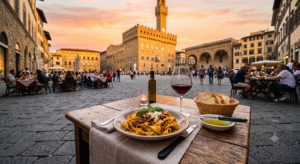
You cannot make a bad choice here. Both nations treat food with immense respect.
Japan: Dining is often highly specialized. You go to a sushi restaurant for sushi, a ramen shop for ramen, and a tonkatsu spot for fried pork. Meals are typically quieter affairs. Dietary restrictions (like strict veganism or gluten-free) are traditionally difficult to accommodate due to the widespread use of fish stock (dashi) and soy sauce, though major cities are improving rapidly.
Italy: Dining is social, loud, and lengthy. A traditional dinner involves multiple courses (antipasto, primo, secondo) accompanied by local wine. Finding vegetarian food is effortless (pizza margherita, pasta pomodoro), and restaurants are highly accommodating.
History, Culture and Attractions
Japan offers a culture built on continuous refinement. You will explore wooden Shinto shrines, Zen rock gardens, and castles. The modern culture is equally fascinating, from neon-lit anime districts to high-end department stores. The etiquette is strict: no eating while walking, keep quiet on trains, and bow respectfully.
Italy offers monumental stone history. You will walk through the Roman Forum, stand under the painted ceiling of the Sistine Chapel, and view original works by Michelangelo. The culture is expressive and tactile. You will hear loud conversations in the streets, experience aggressive driving, and engage in casual banter with shop owners.
Compare Japan rail passes and activity tickets to skip the lines at major cultural sites.
Japan vs Italy for Couples and Honeymoons
Verdict: Choose Italy for classic romance and wine; choose Japan for unique cultural immersion and high-end hospitality.
Japan: Offers incredible experiences for food-focused couples. A stay at a luxury ryokan (traditional inn) with a private hot spring and a multi-course kaiseki dinner is an elite honeymoon experience. It is highly private and respectful.
Italy: The undisputed heavy hitter for traditional romance. Walking along the Amalfi Coast, watching the sunset over the Arno River in Florence, and lingering over a bottle of Chianti perfectly suits couples who want a relaxed, beautiful atmosphere.
Japan vs Italy for Families
Verdict: Japan is safer and easier to navigate with strollers, but Italy’s food is often an easier sell for picky eaters.
Japan: The safety level is a massive relief for parents. Public transport is accessible, and stations have pristine facilities. However, Japan requires an enormous amount of walking, which can exhaust young children.
Italy: Cobblestone streets in Rome or Venice are notoriously hostile to strollers. Logistics with multiple children and luggage on crowded regional trains can be stressful. However, Italian culture loves children, and finding food that kids will actually eat (pizza, pasta, gelato) is incredibly easy.
Japan vs Italy for Solo Travelers
Verdict: Japan is the easiest country in the world for solo travel.
Japan: Solo dining is built into the culture—many ramen shops have individual booths designed specifically for eating alone. Crime is practically non-existent, meaning you can walk alone safely at night.
Italy: Highly social and easy to meet other travelers in hostels or on walking tours. However, solo travelers must remain vigilant against pickpockets and aggressive vendors, particularly around major train stations.
Seven-Day Trip Comparison
Seven days is tight for an international trip, so you must minimize travel time.
A 7-day Japan route: Fly into Tokyo. Spend four days exploring the city. Take the bullet train to Kyoto for three days of temples and traditional culture. Fly out of Osaka.
A 7-day Italy route: Fly into Rome. Spend three days exploring ancient ruins. Take the fast train to Florence for three days of Renaissance art and Tuscan food. Fly out of Florence or Rome.
Which works better? Italy’s major cities are geographically closer together, making a short trip slightly less exhausting, but a focused Tokyo-Kyoto split is highly efficient.
Fourteen-Day Trip Comparison
Two weeks allows you to truly settle into the rhythm of either country.
A 14-day Japan route: Tokyo (4 days) → Hakone for Mt. Fuji views (1 day) → Kyoto (4 days) → Osaka (2 days) → Hiroshima/Miyajima (2 days) → Return to Tokyo (1 day).
Check our complete 14-day Japan itinerary for daily planning.
A 14-day Italy route: Rome (4 days) → Florence and Tuscany (4 days) → Venice (2 days) → Amalfi Coast or Cinque Terre (3 days) → Return to Rome (1 day).
Which offers more variety? Italy provides a better mix of major cities and dramatic coastal relaxation (like the Amalfi Coast), whereas Japan’s primary route is heavily urban.
Seasonal Comparison
Neither country is enjoyable in the peak heat of August.
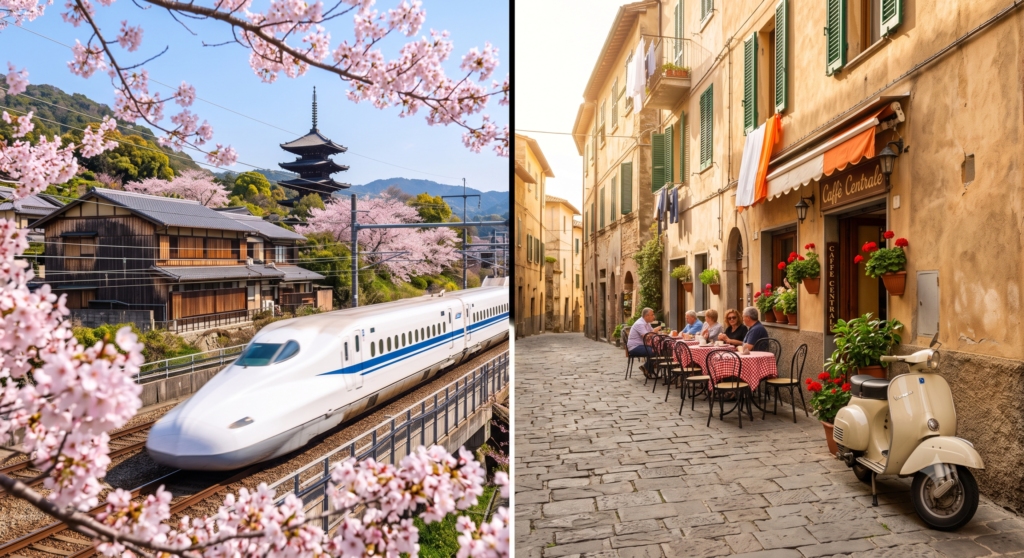
- Spring: Japan’s cherry blossom season (late March to early April) is legendary but incredibly crowded and expensive. Italy in spring offers mild weather and blooming countryside.
- Summer: Japan is oppressively humid with heavy rain. Italy is extremely hot, and coastal areas are packed with European vacationers.
- Autumn: Japan’s autumn foliage (November) rivals its cherry blossoms and offers crisp, clear weather. Italy’s grape harvest season (September-October) is ideal for food and wine lovers.
- Winter: Japan offers world-class skiing in Hokkaido. Italy’s cities empty out, making it a great time for museum-hopping without the crowds.
Common Mistakes
- Overpacking: Dragging heavy suitcases over Italian cobblestones or onto crowded Japanese commuter trains will ruin your travel day. Pack light.
- Underestimating travel time: Looking at a map, destinations seem close. Factoring in hotel check-outs, navigating massive stations, and finding your platform takes hours out of your day.
- Ignoring reservations: You cannot simply walk into the Colosseum in Rome or popular interactive exhibits in Tokyo without booking ahead. Secure major attractions weeks in advance.
- Assuming the JR Pass is always worth it: At ¥50,000 for a 7-day pass, you must travel significantly to break even. Do the math before buying.
Book Italy tours and attraction tickets well in advance to secure your entry times.
Final Decision Table
| Traveler Profile | The Winner | Why |
|---|---|---|
| First international trip | Japan | Everything works flawlessly; navigating transport is straightforward. |
| Couples & Honeymoons | Italy | The undeniable atmosphere of historic European romance. |
| Families | Tie | Japan for safety and logistics; Italy for kid-friendly food. |
| Solo travel | Japan | Normalizes solo dining; incredibly safe environment. |
| Food & History | Italy | Deep regional culinary traditions set against ancient Roman backdrops. |
| Transportation | Japan | The Shinkansen network is clean, fast, and impeccably timed. |
| Moderate budget | Japan | Better value for clean hotels and excellent casual meals. |
| Most distinctive experience | Japan | Feels substantially different from Western cultural norms. |
Final Verdict
Choose Japan if you value safety, cleanliness, and efficiency. It is the perfect destination for travelers who want to experience a highly advanced modern society interwoven with deep historical respect, without the stress of constant logistical delays.
Choose Italy if you want a trip focused on sensory pleasures—incredible wine, long dinners, and wandering through ancient streets. It requires a bit more patience with crowds and infrastructure, but rewards you with unmatched art and history.
Consider visiting both on separate trips if you have the time and budget, as comparing the rigid perfection of Japan to the chaotic beauty of Italy will make you appreciate both even more.
Frequently Asked Questions
Is Japan or Italy cheaper to visit? Japan currently offers better value for mid-range travelers. Clean, central business hotels and high-quality casual meals are significantly cheaper in Japan than in Italy’s major tourist centers.
Is Japan or Italy better for a first international trip? Japan’s incredible safety record and highly organized public transport make it less stressful for beginners, provided you do some research on local etiquette.
Which is better for couples? Italy remains the global standard for romance, offering historic architecture, wine tasting, and coastal views.
Which is better for families? Japan is safer, but Italy is often easier for feeding children and navigating with a slightly looser, louder family dynamic.
Is transportation easier in Japan or Italy? Japan wins easily. The rail network is punctual to the second, whereas Italian regional trains frequently face delays.
Which has better food? It depends entirely on preference. Japan offers precision, clean flavors, and incredible seafood. Italy offers comforting, rich, carb-heavy classics and regional wine.
Is seven days enough for Japan or Italy? It is the bare minimum. You can see Tokyo and Kyoto, or Rome and Florence, but you will be rushing.
Which is better in spring? Japan is famous for spring cherry blossoms, though it is the most crowded time to visit. Italy’s mild spring weather is excellent for walking through ancient sites.
Which is better in autumn? Both are spectacular. Japan offers bright red maple leaves, while Italy offers the autumn harvest season, perfect for truffles and wine.
Can Japan and Italy be combined in one trip? No. They require vastly different flight paths and each deserves at least a dedicated 10-to-14-day itinerary.